
Looking for a way to charge your phone without a plug socket? Whether you’re camping, hiking, travelling abroad or preparing for a power cut, alternative phone chargers can help you stay connected when mains electricity isn’t available.
Solar panels, hand-crank generators, bicycle dynamos and even heat-powered chargers can generate electricity away from the grid. However, they differ considerably in how much power they produce, how practical they are to carry and how long they take to recharge a smartphone.
In this guide, we compare six alternative charging technologies, explain which are genuinely useful for travel and emergencies, and look at the rules for taking portable chargers on flights.
What Is the Best Alternative Phone Charger for Travel?
For most travellers, a fully charged USB-C power bank is the most practical backup. If you expect to spend several days without access to mains electricity, a folding solar panel paired with a power bank is often a more useful option than relying on a hand-crank or motion-powered charger.
The best choice depends on where you’re going, the amount of electricity you need and whether sunlight, movement or fuel will be available.
Alternative Phone Chargers Compared
| Charger type | Power source | Best for | Main limitation |
|---|---|---|---|
| Solar charger | Sunlight | Camping, hiking and extended outdoor trips | Output depends heavily on sunlight and positioning |
| Hand-crank charger | Manual effort | Emergency communication and small top-ups | Very limited power for the effort required |
| Bicycle dynamo | Wheel rotation | Cycle touring and long-distance cycling | Requires a compatible bicycle installation |
| Kinetic charger | Body movement | Experimental or supplementary charging | Typically generates little usable electricity |
| Thermoelectric charger | Heat from a stove or fire | Off-grid camping where cooking fuel is available | Needs heat, ventilation and careful handling |
| Water-activated charger | Water and consumable reactive materials | Specialist emergency applications | Consumables, limited availability and variable output |
| AA battery charger | Replaceable AA batteries | Occasional emergency top-ups | Low capacity and possible compatibility issues |
| USB-C power bank | Stored rechargeable battery | Flights, holidays, commuting and everyday emergencies | Must be recharged and is subject to airline battery restrictions |
Our recommendation: Choose a power bank for ordinary travel, add a folding solar panel for extended off-grid trips, and consider specialist chargers only when they offer a clear advantage for your activities.
1. Solar-Powered Phone Chargers
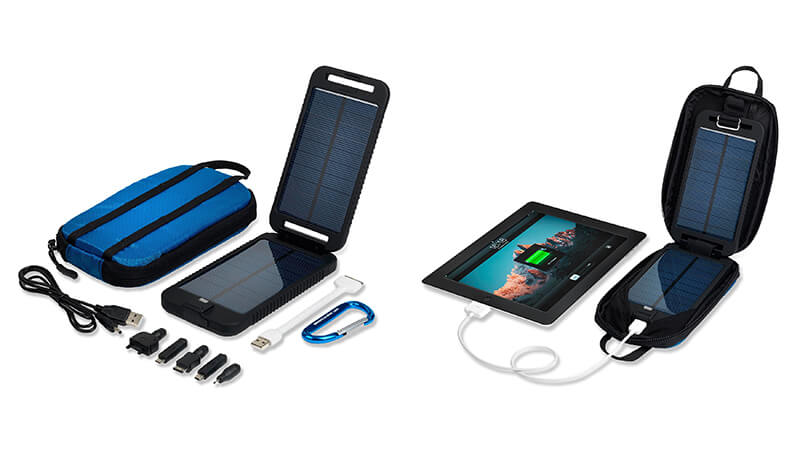
Solar phone chargers use photovoltaic cells to convert sunlight into electricity. They are among the most practical alternative charging options for travellers who spend long periods outdoors.
Portable solar chargers range from small panels designed for occasional USB charging to larger folding panels capable of replenishing a power bank or portable power station.
How well do solar phone chargers work?
Solar chargers work best in strong, direct sunlight, with the panel positioned towards the sun. Clouds, shade, temperature, panel angle and the efficiency of the connected device all affect charging performance.
A panel’s advertised wattage is its rated output under specified test conditions, not the amount of electricity it will continuously produce outdoors.
For more reliable charging, connect the panel to a compatible power bank during daylight hours, then use the stored electricity to charge your phone later.
Examples of portable solar chargers
- Goal Zero Nomad 20: A folding solar panel rated at 20W, with a USB output for charging compatible devices and power packs. The manufacturer’s specifications list a maximum USB output of approximately 10.5W.
- Smaller 5W solar panels: Compact and relatively lightweight, but generally more suitable for gradual charging or replenishing a small battery than rapid smartphone charging.
- Larger folding USB solar panels: Can provide more charging capacity in suitable sunlight, although they require additional space and may be less convenient to carry.
See the Goal Zero Nomad 20 specifications for an example of a manufacturer-documented folding solar charger.
Advantages and disadvantages
Advantages: Renewable energy source, useful for extended outdoor trips, no fuel required and suitable for charging a power bank during daylight.
Disadvantages: Weather-dependent, limited output in shade, slower charging in poor conditions and less useful indoors or overnight.
2. Hand-Crank Phone Chargers
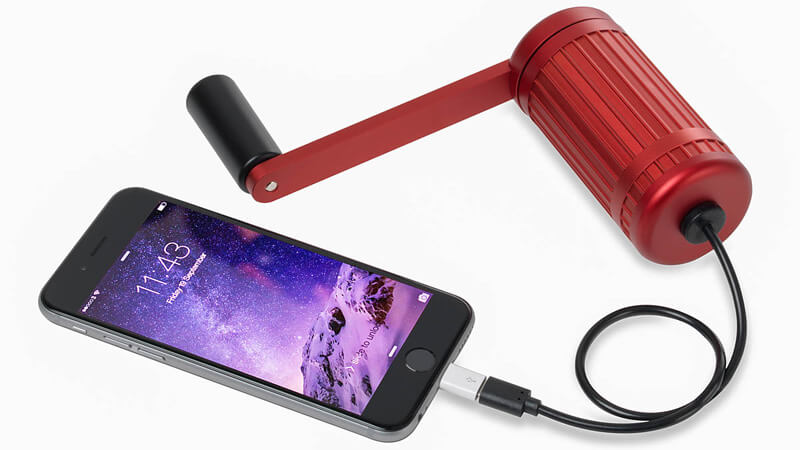
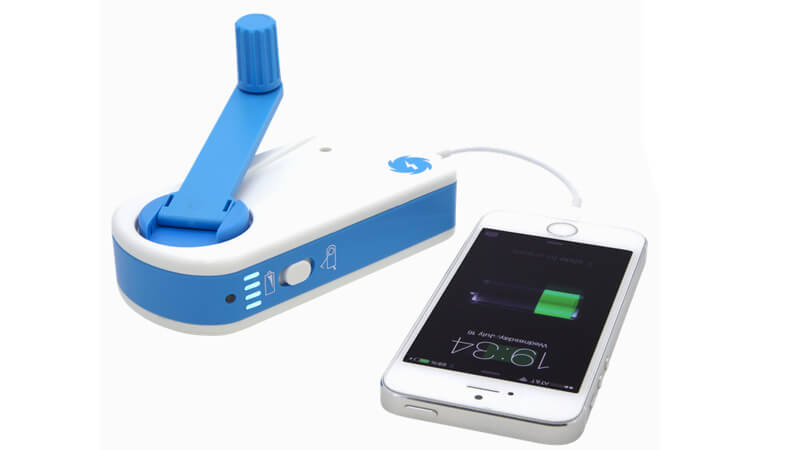
Hand-crank chargers generate electricity when you turn a handle connected to a small generator. They do not require sunlight or mains electricity, making them appealing for emergency kits.
However, producing enough electricity to charge a modern smartphone requires considerably more effort than many older product advertisements suggest.
Can a hand-crank charger fully charge a smartphone?
In principle, yes, if the generator produces suitable power and enough energy is supplied. In practice, fully charging a modern smartphone by hand is usually inconvenient and may require a prolonged period of continuous cranking.
Hand-crank generators are better suited to supplying small amounts of emergency power, especially when combined with an internal battery that can store the electricity generated.
Examples of hand-crank charging technology
Products such as the K-Tor Pocket Socket, SOSCharger and Eton BoostTurbine demonstrated different approaches to manual charging. These are useful historical examples, but their current availability, compatibility and performance should be checked before considering a purchase.
Best for: Emergency kits where a small amount of power may be valuable and other electricity sources are unavailable.
Not ideal for: Travellers who need to recharge smartphones regularly or run power-hungry devices.
3. Bicycle Dynamo Chargers
Bicycle dynamo systems generate electricity from wheel movement while cycling. With the right charging equipment, that electricity can be used to power lights, recharge a buffer battery or charge a compatible electronic device.
For long-distance cyclists, a dynamo can be more practical than a handheld generator because it produces power while you are already travelling.
However, output depends on riding speed, generator design and the charging electronics. A buffer battery can help provide a more consistent supply when you slow down or stop.
Earlier systems included products such as the Tigra Sport BikeCharge. Modern alternatives should be selected according to your bicycle’s dynamo compatibility, USB output requirements and intended journey.
Best for: Cycle touring, bikepacking and extended bicycle journeys.
4. Kinetic Phone Chargers: Can Walking Charge Your Phone?
Kinetic chargers attempt to capture energy from movement, such as walking or running, and convert it into electricity.
The idea is attractive: simply carry a device while moving and generate power without needing a socket, sunlight or fuel.
However, the amount of recoverable energy from everyday body movement is generally small compared with the electricity required by modern smartphones.

Does kinetic charging really work?
Yes, movement can be converted into electricity, but the practical output of small wearable systems is limited. They should not be relied upon as the main charging method for a smartphone during travel.
AMPY Move was one of the better-known attempts to commercialise wearable motion-powered charging. It remains an interesting example of the technology, rather than a current recommendation for travellers.
Our view: If you are walking or hiking for several days, a solar panel and power bank will usually be a more useful combination than a small kinetic charger.
5. Heat-Powered Phone Chargers
Thermoelectric chargers generate electricity using a temperature difference. Some camping products incorporate this technology into wood-burning stoves, allowing heat from cooking to produce electricity.
This can be useful when camping away from mains electricity, particularly if you already carry a suitable stove and fuel.
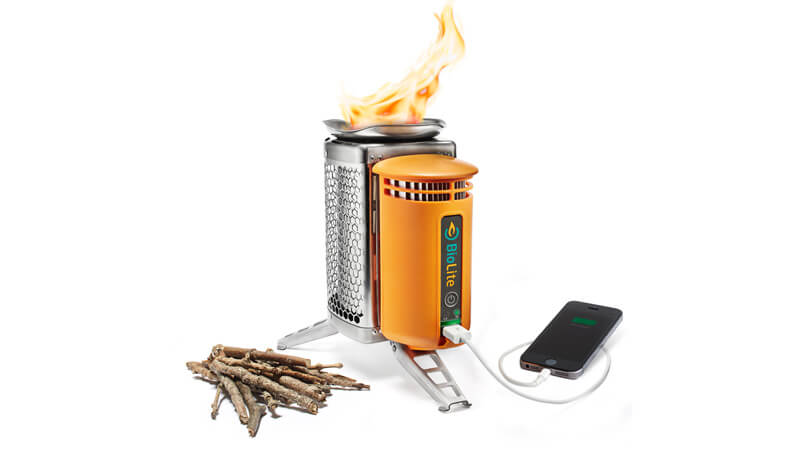
How does a heat-powered charger work?
A thermoelectric generator converts a temperature difference between two surfaces into electrical energy. A camping stove can provide the hot side, while a cooling system maintains a lower temperature on the other side.
Electricity output depends on the design, heat source and temperature difference. Some devices store generated energy in an internal battery for later use.
Examples of heat-powered chargers
The BioLite CampStove series is a recognised example of combining a camping stove with thermoelectric electricity generation. Earlier products such as the PowerPot and FlameStower also explored using cooking heat to charge small electronic devices.
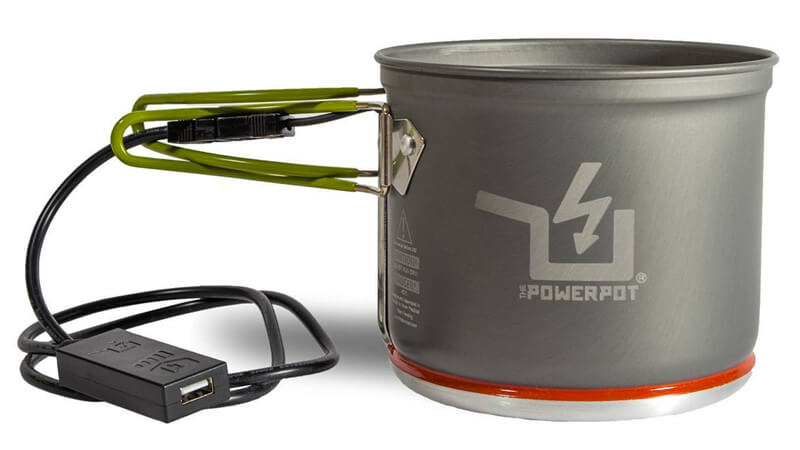
These technologies can be useful in specialist situations, but do not assume that an older model remains available or that its original charging claims apply to modern smartphones.
Important safety considerations
- Never use a fuel-burning camping stove inside a tent, vehicle or poorly ventilated enclosed space.
- Follow the manufacturer’s instructions for ventilation, fuel and safe operation.
- Keep charging cables and electronic devices away from flames and hot surfaces.
- Allow the equipment to cool before packing it.
- Remember that fuel-burning devices may be restricted in airline baggage, particularly if they contain fuel or fuel residue.
Best for: Off-grid camping where a suitable stove is already part of your equipment.
6. Water-Activated Phone Chargers and Fuel Cells
Some specialist emergency chargers use water to activate a chemical reaction that generates electricity. These are sometimes described as water-powered chargers, although the water is not the sole source of energy.
Instead, the electricity comes from a chemical reaction involving consumable materials, with water helping to activate the process.
Can water really charge a phone?
Yes, certain electrochemical systems can generate electricity after water is added. However, the amount of usable power depends on the materials, cell capacity and design.
Examples of this technology include magnesium-air systems and earlier fuel-cell concepts such as myFC JAQ.
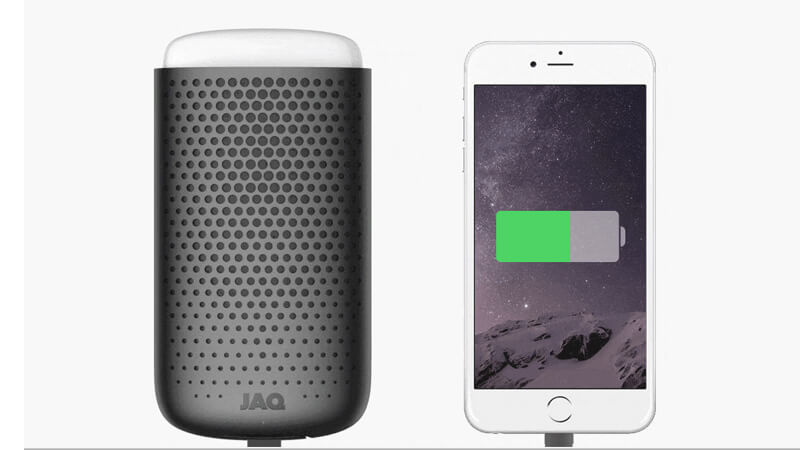
These products are better understood as specialist or historical examples rather than mainstream alternatives to rechargeable power banks.
Important for air travellers: Fuel cells, replacement cartridges and chemical charging systems may be subject to dangerous-goods restrictions. Do not assume they are permitted in cabin or checked baggage simply because they are inactive or contain no conventional lithium battery.
Check the exact product and cartridge specifications with your airline before travelling.
7. AA Battery Phone Chargers
AA-powered phone chargers use replaceable batteries to provide electricity through a suitable voltage converter and charging connector.
They can be useful in emergencies because AA batteries are widely available, but their limited energy capacity means they are generally better for small top-ups than full smartphone charges.
Older products such as The Nipper demonstrated how a small number of AA batteries could provide emergency charging power.
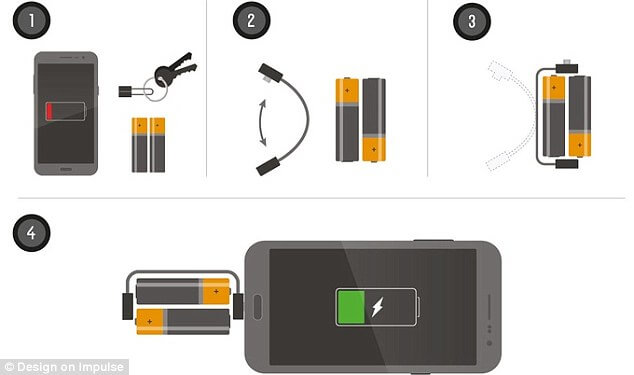
However, compatibility with modern USB-C phones and the available charging output must be checked. The fact that a charger accepts AA batteries does not guarantee it can reliably charge every smartphone.
Best for: Occasional emergency use when compatible equipment and suitable batteries are available.
8. USB-C Power Banks: The Most Practical Travel Backup
Although conventional power banks do not generate their own electricity, they remain one of the most useful ways to keep a phone charged while travelling.
A power bank stores electricity in a rechargeable battery and supplies it to compatible devices through USB connections.
Unlike solar, kinetic or hand-crank chargers, a fully charged power bank can deliver electricity immediately without depending on weather, movement or fuel.
What size power bank should you choose?
| Typical capacity | Suitable use | What to consider |
|---|---|---|
| 5,000mAh | Short journeys and emergency top-ups | Compact, but limited capacity |
| 10,000mAh | Day trips, flights and everyday travel | A practical balance of capacity and portability |
| 20,000mAh | Long journeys and multiple devices | More capacity, but heavier and slower to recharge |
| 30,000mAh or more | Extended off-grid use | Check the Watt-hour rating carefully, particularly before flying |
The number of phone charges you can obtain depends on battery capacity, voltage, charging losses and the phone itself. A 10,000mAh power bank does not necessarily provide two complete charges to a phone with a 5,000mAh battery.
For everyday holidays, a reputable USB-C power bank with sufficient output for your phone is generally a more practical choice than a specialist alternative-energy charger.
Can You Take Alternative Phone Chargers on a Plane?
Many portable chargers can travel by air, but the rules depend on whether they contain lithium batteries, fuel, chemicals or other restricted components.
Under Civil Aviation Authority provisions introduced on 27 March 2026, passengers are limited to a maximum of two power banks per person. Power banks must be carried in cabin baggage, protected against short circuits and must not be recharged during the flight.
The CAA also advises against using power banks to recharge other portable electronic devices on board. Check with your airline before attempting to use one during a flight.
Power bank capacity limits for flights
| Battery capacity | General UK aviation guidance |
|---|---|
| Up to 100Wh | Generally permitted in cabin baggage without airline approval, subject to other restrictions. |
| Over 100Wh up to 160Wh | Requires airline approval. |
| Over 160Wh | Not permitted in ordinary passenger baggage. |
To calculate battery capacity in Watt-hours, multiply the battery’s nominal voltage by its capacity in amp-hours.
Wh = (mAh × nominal voltage) ÷ 1,000
For example, a 20,000mAh power bank with a nominal battery voltage of 3.7V has a capacity of approximately 74Wh.
Use the manufacturer’s stated Watt-hour rating whenever available.
Solar panels without batteries are different from power banks, but chargers incorporating batteries must meet the applicable battery rules. Fuel-powered, chemical and water-activated systems may require additional checks.
Read the CAA’s Pack Right, Safe Flight guidance and its March 2026 power-bank rule changes.
For further airport-specific advice, see our guide to electronic devices, phone chargers and security rules at Gatwick Airport.
How to Choose a Portable Charger for Your Trip
Before buying a charger, consider how you intend to use it rather than focusing solely on its advertised capacity or charging speed.
- Consider your destination: A solar panel may be useful on a sunny camping trip but less effective in a shaded city environment.
- Estimate your power needs: Navigation, photography, video recording and mobile data can increase battery consumption.
- Check USB compatibility: Make sure the charger supports your device’s connector and required charging output.
- Compare weight and size: A large solar panel or camping stove may be impractical for ordinary holidays.
- Check airline restrictions: Battery capacity, fuel and chemical components may affect whether a charger can travel by air.
- Consider reliability: Established manufacturers, clear specifications and suitable safety certification are preferable to unsupported performance claims.
- Plan a backup: If your phone is essential for navigation or communication, do not rely entirely on a weather-dependent or experimental charger.
How to Make Your Phone Battery Last Longer While Travelling
Reducing battery consumption can be just as useful as carrying additional charging equipment.
- Enable your phone’s low-power or battery-saver mode.
- Reduce screen brightness and shorten the screen timeout.
- Download maps and travel documents for offline access.
- Limit unnecessary background activity and location tracking.
- Avoid leaving your phone in direct sunlight or extreme heat.
- Carry the correct USB cable and charging adaptor.
- Keep some battery capacity available for emergencies.
If you’re driving abroad, remember that many countries restrict handheld phone use while driving. Read our guide to mobile phone rules when driving in Europe before setting off.
Frequently Asked Questions About Alternative Phone Chargers
Do solar phone chargers work on cloudy days?
Yes, solar panels can generate electricity in cloudy conditions, but their output is usually lower than in direct sunlight. Charging may be considerably slower, depending on cloud cover, panel size and positioning.
Can you charge a phone using only sunlight?
Yes. A compatible solar panel can charge a smartphone directly when sufficient sunlight is available. However, using a suitable power bank between the panel and phone can provide more consistent charging.
How long does a hand-crank charger take to charge a phone?
It depends on the generator’s electrical output, the effort applied and the phone’s battery capacity. Small hand-crank devices are generally better for limited emergency power than fully charging a modern smartphone.
Can walking or running charge your phone?
Movement can be converted into electricity, but small wearable kinetic generators typically produce limited power. They are not usually a practical replacement for a power bank or solar charger.
Are water-powered phone chargers real?
Yes. Some specialist systems use water to activate an electrochemical reaction that generates electricity. The energy comes from consumable reactive materials rather than water alone.
What is the best charger for camping without electricity?
For many campers, a folding solar panel combined with a suitable power bank offers a useful balance of portability and charging capacity. A thermoelectric stove may be an option if you already carry compatible cooking equipment.
Can I take a solar charger in hand luggage?
A solar panel without an integrated battery is generally less restricted than a lithium battery power bank. However, panels containing batteries and other specialist equipment must meet applicable airline rules. Always check the exact product before travelling.
How many power banks can I take on a plane?
Under the CAA’s March 2026 provisions, passengers may carry a maximum of two power banks per person. They must be carried in cabin baggage, meet applicable capacity limits and must not be recharged during the flight.
Is a 20,000mAh power bank allowed on a plane?
Usually, yes. A typical 20,000mAh lithium-ion power bank rated at a nominal 3.7V has a capacity of approximately 74Wh, below the standard 100Wh threshold. Check the product’s actual Watt-hour rating and your airline’s requirements.
Are older alternative phone chargers still worth buying?
Some older products may still be useful, but check whether replacement batteries, cables, cartridges and manufacturer support remain available. Avoid relying on historic prices or charging claims when comparing older products with modern smartphones.
Final Thoughts: Which Phone Charger Should You Take?
Alternative phone chargers offer useful ways to generate electricity when conventional charging points are unavailable, but their practical value varies considerably.
Solar chargers are among the most useful options for extended outdoor trips, bicycle dynamos can suit long-distance cyclists, and hand-crank or specialist emergency generators may provide limited backup power.
For most holidays, however, a reliable USB-C power bank remains the simplest solution. Charge it before departure, check its airline compatibility and carry it safely in your cabin baggage.
If you’re flying from a UK airport, you can also plan your journey in advance with APH Airport Parking & Hotels, family-owned since 1980, and compare airport parking options before travelling.
Last reviewed: 19 November 2026. Older charger models are included to explain the technology and are not presented as confirmed current products. Specifications, prices, availability and airline requirements may change. Always check manufacturer information and airline guidance before purchasing or travelling with specialist charging equipment.