
The travel industry has undergone a number of changes in recent decades, brought on by shifting customer behaviours and technological innovations. From online travel agencies to social media influence, the way we plan and book trips is moving more towards personalisation, flexibility, and convenience.
In this travel booking report, we’ve compiled data on how people book travel, how they choose destinations, and the role of Artificial Intelligence (AI) in the travel planning process.
Key Findings
- The most used travel booking resource is online travel agents (e.g. Booking.com), with 80% of global travellers using these in the lead-up to booking a trip.
- The average time between booking a trip and departing on the trip is 73 days.
- The most popular travel booking method among UK travellers is direct bookings via airline and hotel websites (51%), followed by online travel agencies (48%).
- When booking airport parking, the average time between booking and trip departure is 39.08 days.
- 20% of UK travellers would feel comfortable using AI to plan a trip in 2025, an increase from 15% in 2024, but 49% still feel uncomfortable using AI for travel planning.
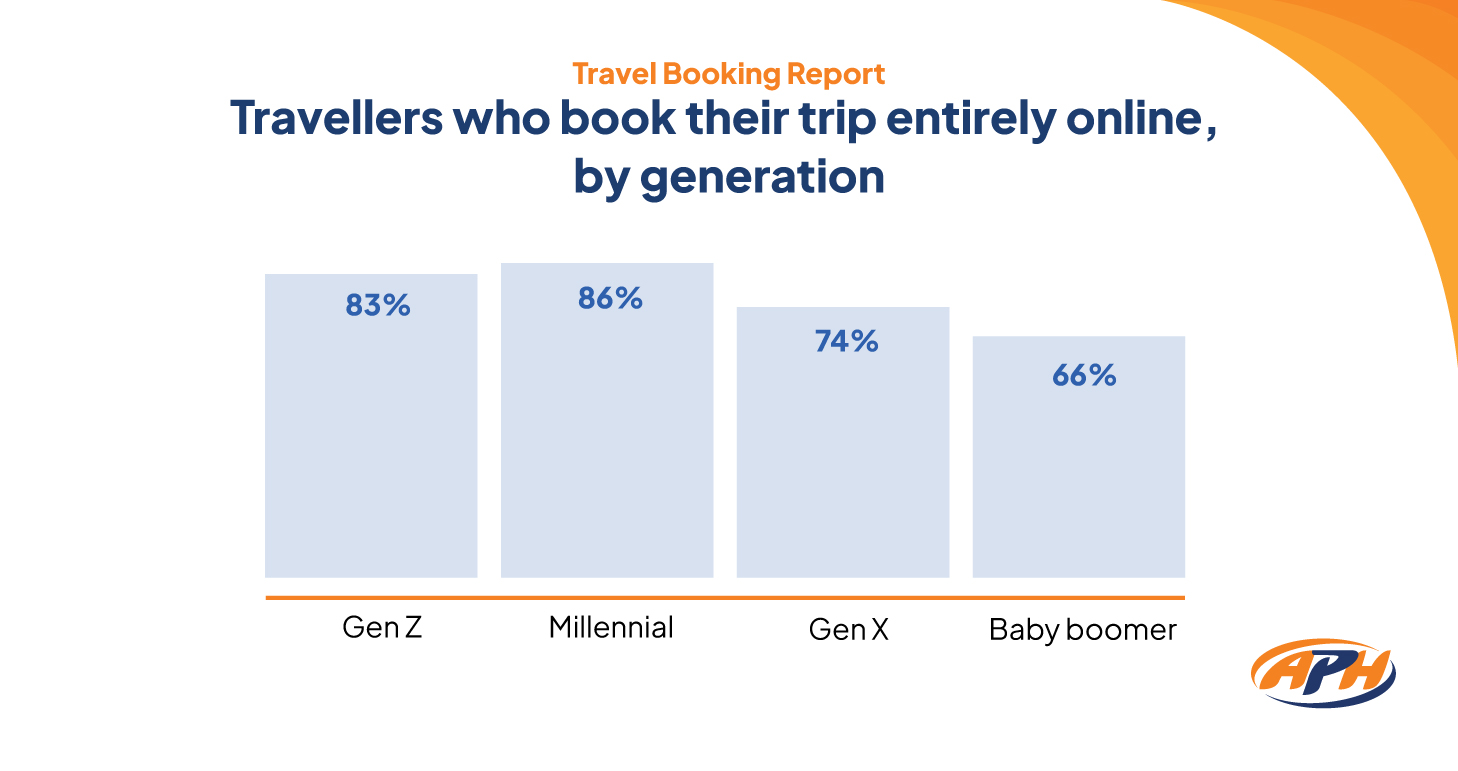
- Millennials are the most likely to book a trip entirely online (86%), while baby boomers are the least likely (66%).
- Travellers can save an average of £364 on a one-week trip by booking with an online travel agent rather than in a high street store.
- The best-rated accommodation booking platform is Booking.com with a customer score of 73%, followed by Airbnb with a customer score of 71%.
The most used travel planning resources
In the lead-up to a travel booking, we might use a number of resources to get inspiration, find accommodation and compare prices.
The most commonly used resources in the 45 days before a travel purchase are online travel agencies like Expedia and Booking.com, with 80% of global travellers saying they use these sites while planning a trip.
Other commonly used resources in the travel booking process include search engines (61%), social media (58%), and airline websites (54%).
| Resource | Percentage of travellers (%) |
| Online travel agencies | 80% |
| Search engine | 61% |
| Social media | 58% |
| Airline site | 54% |
| Meta travel site | 51% |
| Hotel site | 36% |
| Destination site | 12% |
| Car rental | 11% |
| Travel media | 10% |
| Financial services | 8% |
Source [1]
Most common travel booking methods
The process of booking travel has shifted primarily to online platforms in recent decades, with the use of in-person travel agencies declining in popularity. The UK online travel booking market size is predicted to reach $59.6 billion by 2030. [2]
Data from 2023 shows that 66% of all travel bookings among European travellers take place online, with mobile bookings making up 35% of all online sales. [3]
For British travellers, booking directly via airline and hotel websites is the most common way to book travel (51%), followed by the use of online travel agencies (48%). Mobile apps like Airbnb and Hopper have experienced a rise in popularity in recent years, with 28% of travellers in the UK now using them. Though offline travel agencies have seen a decline over time, 24% of British travellers still use them when booking a trip.
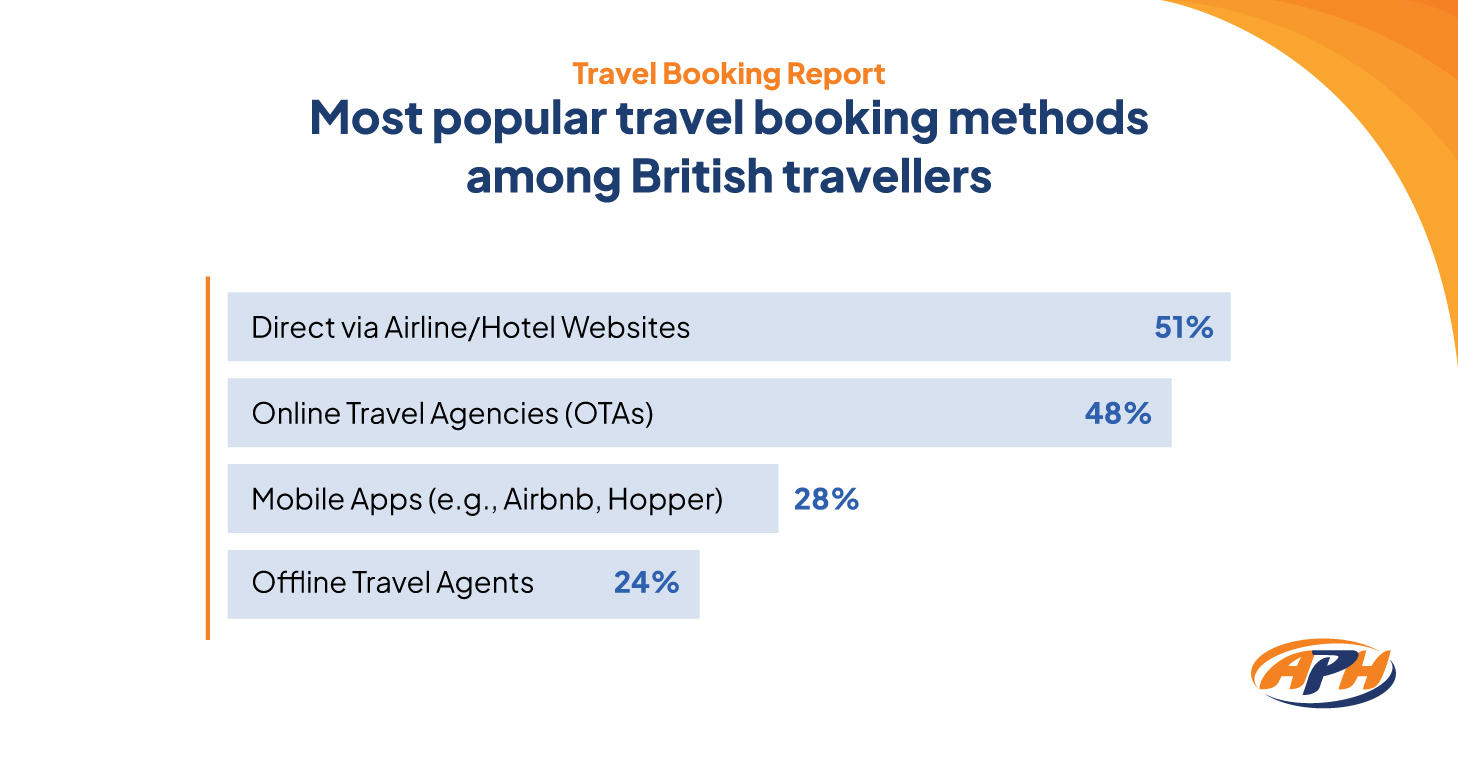
Data note: Respondents could select more than one answer.
Source [4]
Millennials are most likely to book their entire trip online
A study into global travellers found that 80% think it’s important that they can book their trip entirely online. When breaking down the data by generation, millennials are the most likely to use online platforms to book their entire trip (86%), closely followed by Gen Z (83%).
Baby boomers are less likely to book all of their travel components online; however, two-thirds (66%) still do this.
Source [5]
Booking.com is the most visited travel and tourism website
Global web traffic data shows that Booking.com is the most visited travel website by some way, with an average of 562.64 million monthly visitors. TripAdvisor came in second with 150.22 million monthly visitors, and Airbnb ranked third (105.4 million monthly visitors).
| Travel site | Average global monthly visits (millions) |
| Booking.com | 562.64 |
| TripAdvisor | 150.22 |
| Airbnb | 105.4 |
| American Express | 100.75 |
| Agoda | 92.8 |
| IRCTC | 89.99 |
| Ryanair | 84.17 |
| Wetter | 80.1 |
| Trip.com | 77.39 |
| Flight Radar 24 | 72.39 |
Source [6]
Travel booking timelines
The stages of travel planning can vary from person to person and trip to trip, but global traveller data reveals the typical timeline for planning and booking a trip.
On average, the time it takes a traveller to go from initially considering a trip to booking it is 71 days, with 33 days spent looking for inspiration, and 38 days spent researching and planning.
The average time between booking and taking a trip is 73 days. But this timing varies for different types of travel; business travellers typically book closer to departure (43 days), and international travellers have longer purchase paths (85 days).
Source [1]
How far in advance do Brits book travel?
The time that we book travel can have a big impact on the cost, availability, and flexibility in terms of amending and cancelling bookings.
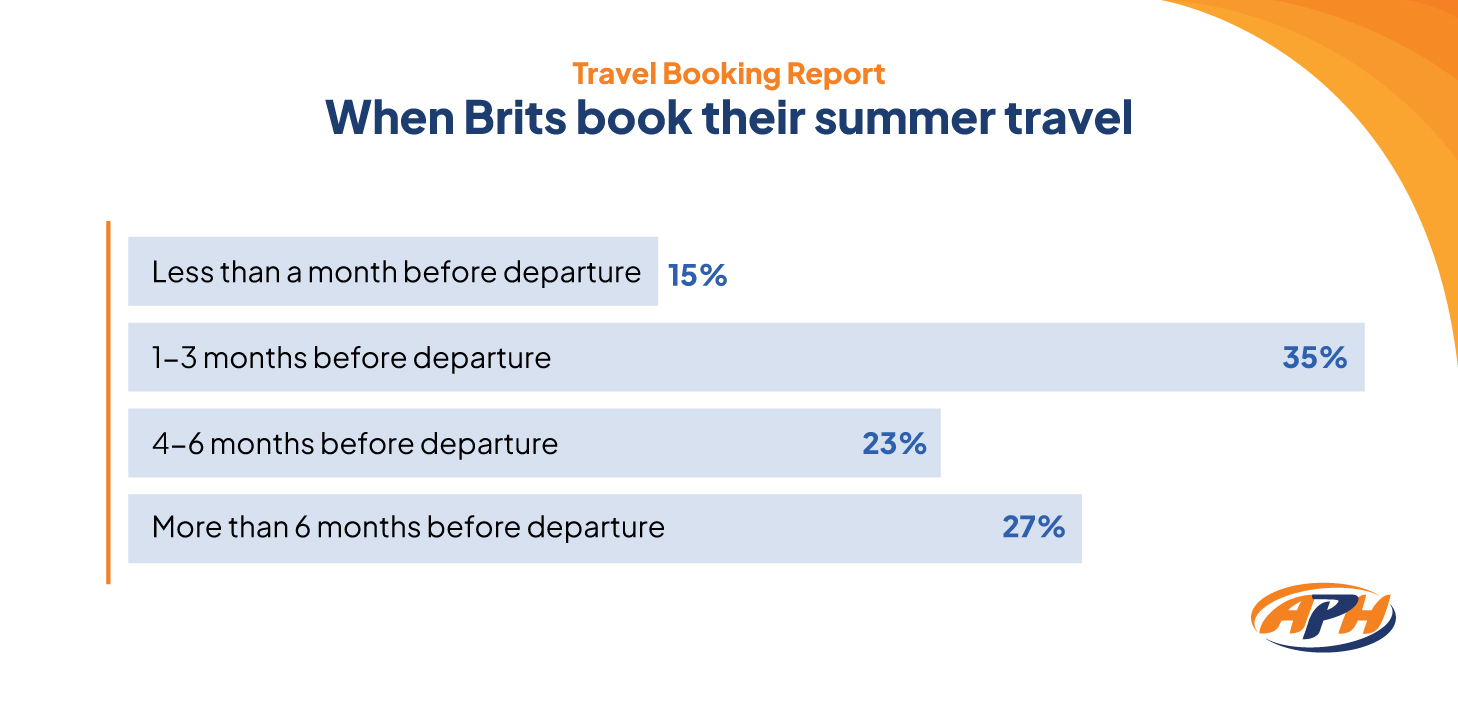
UK data shows that 35% of Brits book travel between one and three months before departure, making this the most common travel booking timeline. Around a quarter (27%) book trips more than six months before they depart, and 15% prefer last-minute travel, booking less than one month before departure.
Source [7]
Reasons for travel booking timelines
Travellers have different reasons for booking their trips at certain times, with some focusing more on convenience, and others being more concerned with the price of their trip.
For those who book summer travel less than a month before departure, the most common reason is flexibility (20%), while 18% were booking late based on friends’ or family’s schedules.
For travellers booking between one and three months before departure, the main reasons are family and friends’ schedules (18%), and a preference for planning ahead (16%).
Among those who booked between four and six months ahead of departure, 30% do this because they prefer planning ahead, and 16% cited concerns about price increases if they left booking until later.
The main reason people book travel more than six months before departure is that they prefer planning ahead (29%), while 19% do this to ensure the availability of their desired accommodation or flights.
| Reason | Less than 1 month before departure | 1–3 months before departure | 4–6 months before departure | More than 6 months before departure |
| Flexibility in travel dates | 20% | 11% | 5% | 3% |
| Family or friends’ schedules | 18% | 18% | 10% | 10% |
| Availability of desired accommodation(s) or flight(s) | 13% | 11% | 15% | 19% |
| Special promotions or discounts | 9% | 7% | 7% | 11% |
| Concern about price increases | 6% | 13% | 16% | 13% |
| Preference for planning ahead | 4% | 16% | 30% | 29% |
| Uncertainty about travel restrictions | 3% | 3% | 1% | 0% |
| Other | 6% | 3% | 2% | 3% |
| Don’t know | 7% | 4% | 2% | 2% |
Source [7]
When do people book airport parking?
For those jetting off on an international trip or travelling by air within the UK, booking airport parking can be a crucial part of ensuring your travels get off to a good start.
APH’s internal UK airport parking data shows that 132,522 bookings were made between the 1st of June and the 20th of August. The average time between these bookings and the date of departure is 39.08 days, but 20% of bookings were made on the day of departure (26,527 in total). During this period, the longest time between airport parking booking and departure was 777 days, with a booking made on the 4th of August for a stay on the 20th of September 2027.
Where people get their travel booking inspiration from
People find travel inspiration from a number of different sources, including family and friends, social media, and particular events.
Initial trip inspiration
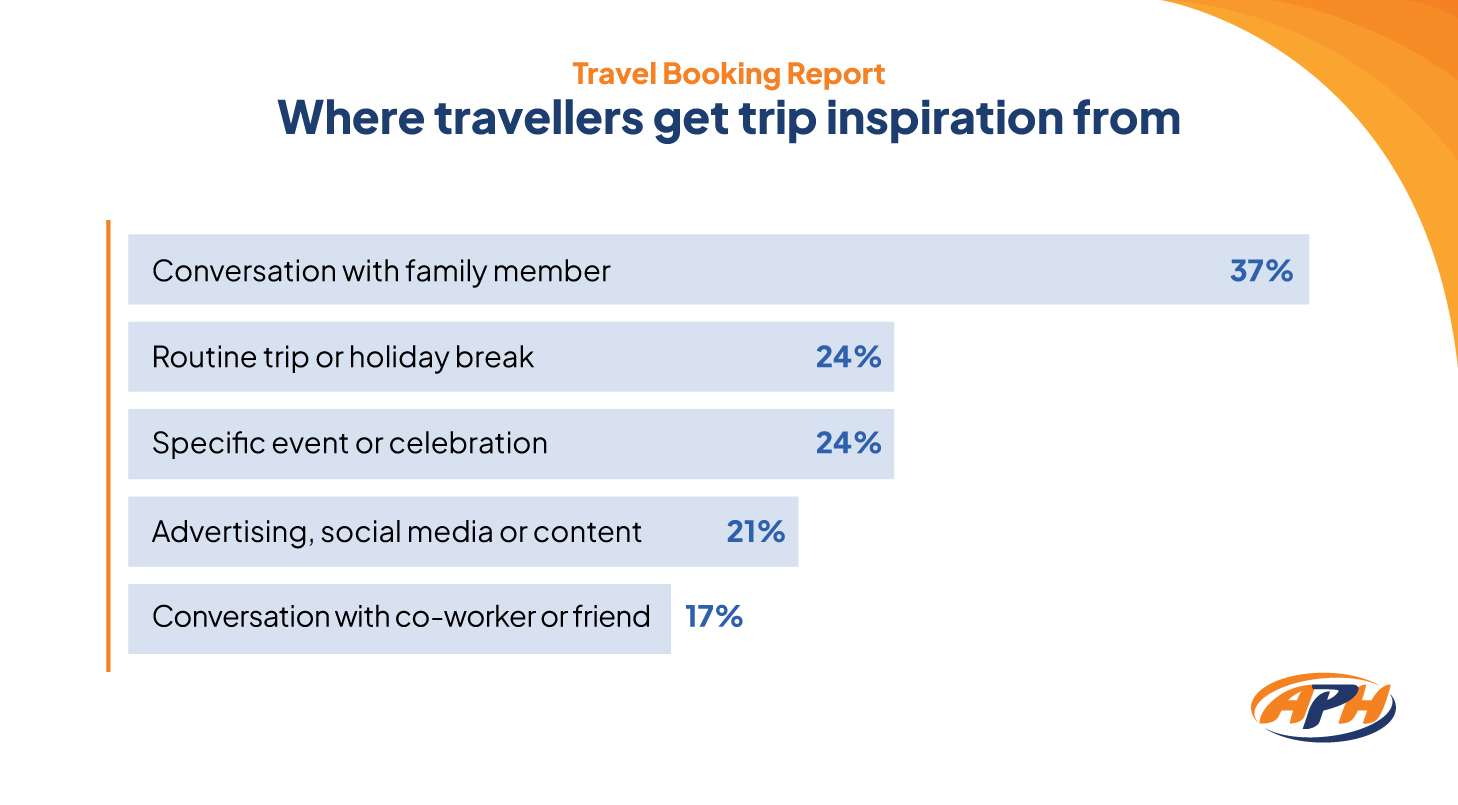
Among travellers who booked a trip in the last six months, the most common source of initial trip inspiration was conversations with family members (37%). Conversations with coworkers gave travel inspiration to 17% of travellers, suggesting that personal recommendations are key when it comes to making travel decisions.
Source [1]
The most common resources used for travel inspiration
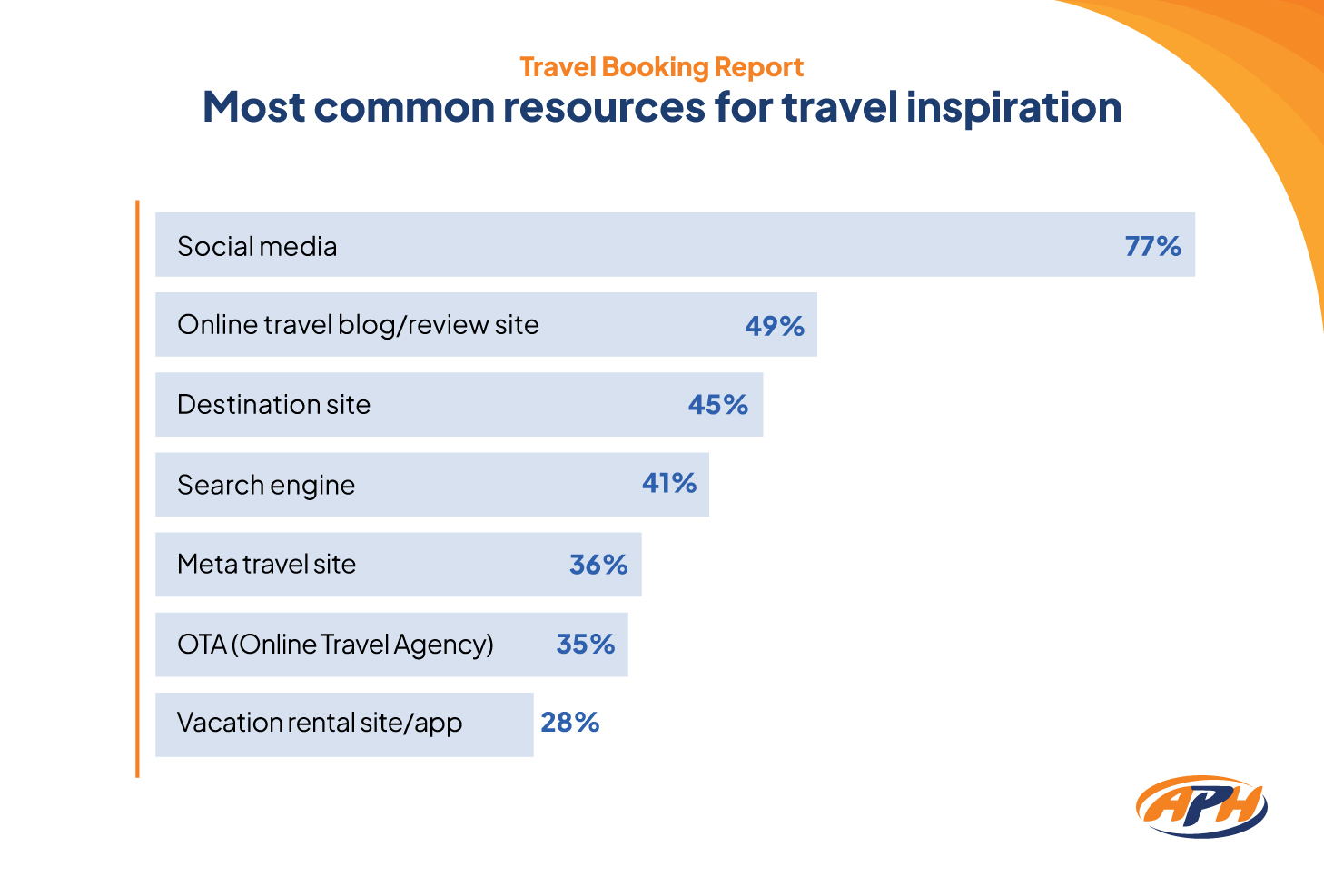
When actively looking for travel inspiration, the most common resource travellers use is social media, with 77% saying this is part of their initial travel planning stage. This is followed by online travel blogs and review sites, which almost half (49%) of travellers use to find inspiration for their trip, and destination-specific sites (45%).
Source [1]
What do British travellers look for when booking accommodation?
The most common accommodation type for British travellers is hotels, with 68% typically choosing this option when travelling. When it comes to booking accommodation for a trip, there are a number of things travellers consider before they commit.
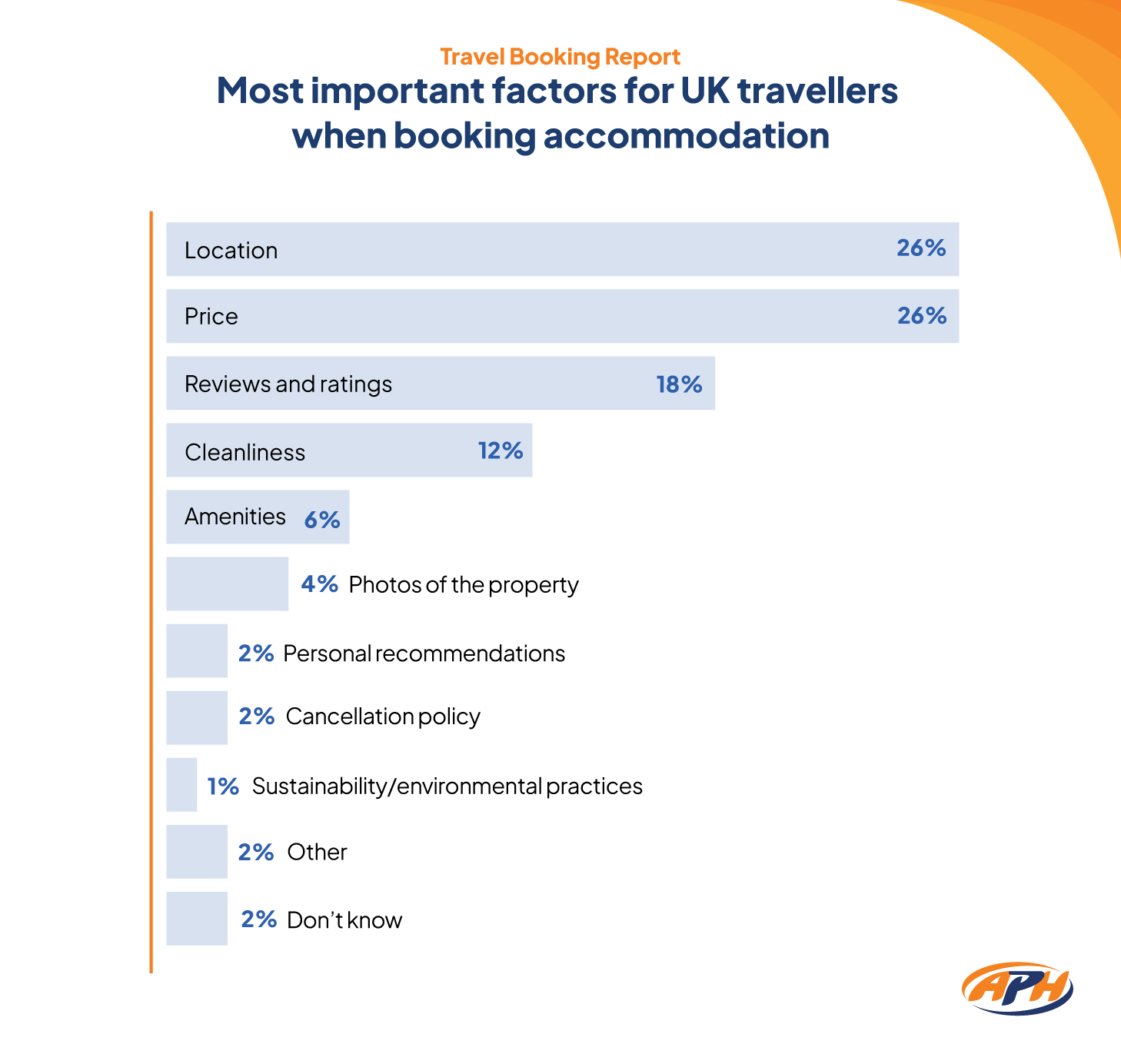
Across all travellers, the most important considerations when booking accommodation are location and price, with each of these being the most important factor for 26% of people. This is followed by reviews and ratings (18%) and cleanliness (12%).
Data note: Respondents were asked to choose one option as their most important consideration when booking accommodation.
Source [8]
Accommodation booking priorities by age
The key factors people look for when booking accommodation vary by age; younger travellers tend to be more concerned with price, while location is more important for older travellers.
Data shows that for 32% of 18-24-year-olds, price is the biggest priority when booking accommodation for a trip, and 28% of 25-34-year-olds had the same priority. For travellers aged 55 and over, location is the most important consideration (31%), followed by price (21%). Reviews and ratings are the third most common priority for all age groups, and younger travellers (18-24) are most likely to consider photos of the property when planning a trip (8%).
| Accommodation booking priorities by traveller age | |||||
| Booking priority | 18-24 | 25-34 | 35-44 | 45-54 | 55+ |
| Location | 18% | 22% | 21% | 27% | 31% |
| Price | 32% | 28% | 26% | 29% | 21% |
| Reviews and ratings | 28% | 22% | 22% | 14% | 15% |
| Cleanliness | 10% | 11% | 8% | 12% | 14% |
| Amenities | 4% | 5% | 7% | 8% | 6% |
| Photos of the property | 8% | 4% | 5% | 3% | 3% |
| Personal recommendations | 2% | 4% | 2% | 1% | 3% |
| Cancellation policy | 0% | 1% | 3% | 2% | 2% |
| Sustainability/environmental practices | 1% | 2% | 2% | 0% | 1% |
| Other | 1% | 0% | 2% | 3% | 3% |
| Don’t know | 6% | 2% | 1% | 2% | 1% |
Data note: Respondents were asked to choose one option as their most important consideration when booking accommodation.
Source [8]
Price differences between online and in-store travel agents
We may have different preferences for where we look when booking travel and accommodation for a trip. Some travellers prefer the personalised approach of an in-store travel agent, while others want the convenience of booking everything online.
A study by Which? found that travellers could be paying significantly more by booking through an in-person travel agent compared with the same travel agents’ online booking services.
Co-op Travel had the biggest difference between in-store and online prices for a two-week trip to the Dominican Republic (£411); however, shoppers were able to negotiate this difference down to £126 in-store.
Tui had the smallest difference between in-store and online prices for the same trip, with the in-store price being only £5 more.
| Price differences between in-store and online travel agents for a two-week trip to the Dominican Republic | ||||
| High street store | In-store price | Online price | Difference | In-store price after haggling |
| Co-Op Travel | £3,190 | £2,779 | £411 | £2,905 |
| Hays Travel | £4,525 | £4,156 | £369 | £4,206 |
| Kuoni | £3,030 | £2,780 | £250 | £3,030 |
| Tui | £4,102 | £4,097 | £5 | £4,102 |
Source [9]
The data shows a similar pattern for a one-week trip to Marbella; however, Kuoni had the biggest difference in price for this trip (£887 more when booking in-store). Even after haggling, Kuoni’s in-store price was still £680 more than their online price.
Tui quoted exactly the same price for one week in Marbella, both in-store and online (£2,474), and did not change their price in response to haggling.
| Price differences between in-store and online travel agents for a one-week trip to Marbella | ||||
| High street store | In-store price | Online price | Difference | In-store price after haggling |
| Co-Op Travel | £1,686 | £1,352 | £334 | £1,292 |
| Hays Travel | £2,742 | £2,507 | £235 | £2,742 |
| Kuoni | £3,474 | £2,587 | £887 | £3,267 |
| Tui | £2,474 | £2,474 | £0 | £2,474 |
Source [9]
AI and travel booking
AI is becoming more ingrained in our daily lives, and that’s no different when it comes to the travel booking process. A study of British people found that 20% would feel comfortable using AI during travel planning in 2025, an increase from 15% in 2024.
However, almost half of people are still uncomfortable with the idea of using AI to make their travel plans (48%), though this has reduced slightly compared to 2024 (49%).
There is also a gender difference in those who are happy using AI in the travel planning process; men are typically more comfortable with it (22%), with women being slightly less so (19%).
The use of AI for travel planning by age group
You might think younger travellers would be more comfortable using emerging technology like AI when planning a trip, but 47% of 18-24s would not feel happy using it. Those in the 25-34 age range are the most content with using AI tools in their travel planning process (35%); however, 40% of holiday goers in this age group still don’t feel completely comfortable with it.
Older travellers aged 55 and over have the biggest reservations around AI use in the travel booking process, with only 10% saying they’d be happy to use it, and 58% feeling uncomfortable about it.
| How comfortable travellers feel using AI to book travel (by age) | ||||
| Group | Comfortable | Neutral | Not comfortable | Don’t know |
| 18-24 | 28% | 21% | 47% | 4% |
| 25-34 | 35% | 20% | 40% | 5% |
| 35-44 | 22% | 24% | 39% | 16% |
| 45-54 | 21% | 29% | 41% | 9% |
| 55+ | 10% | 23% | 58% | 10% |
Source [10]
How people use AI for travel planning
AI has a number of applications across the travel industry, from comparing destinations to finding deals on flights and hotels.
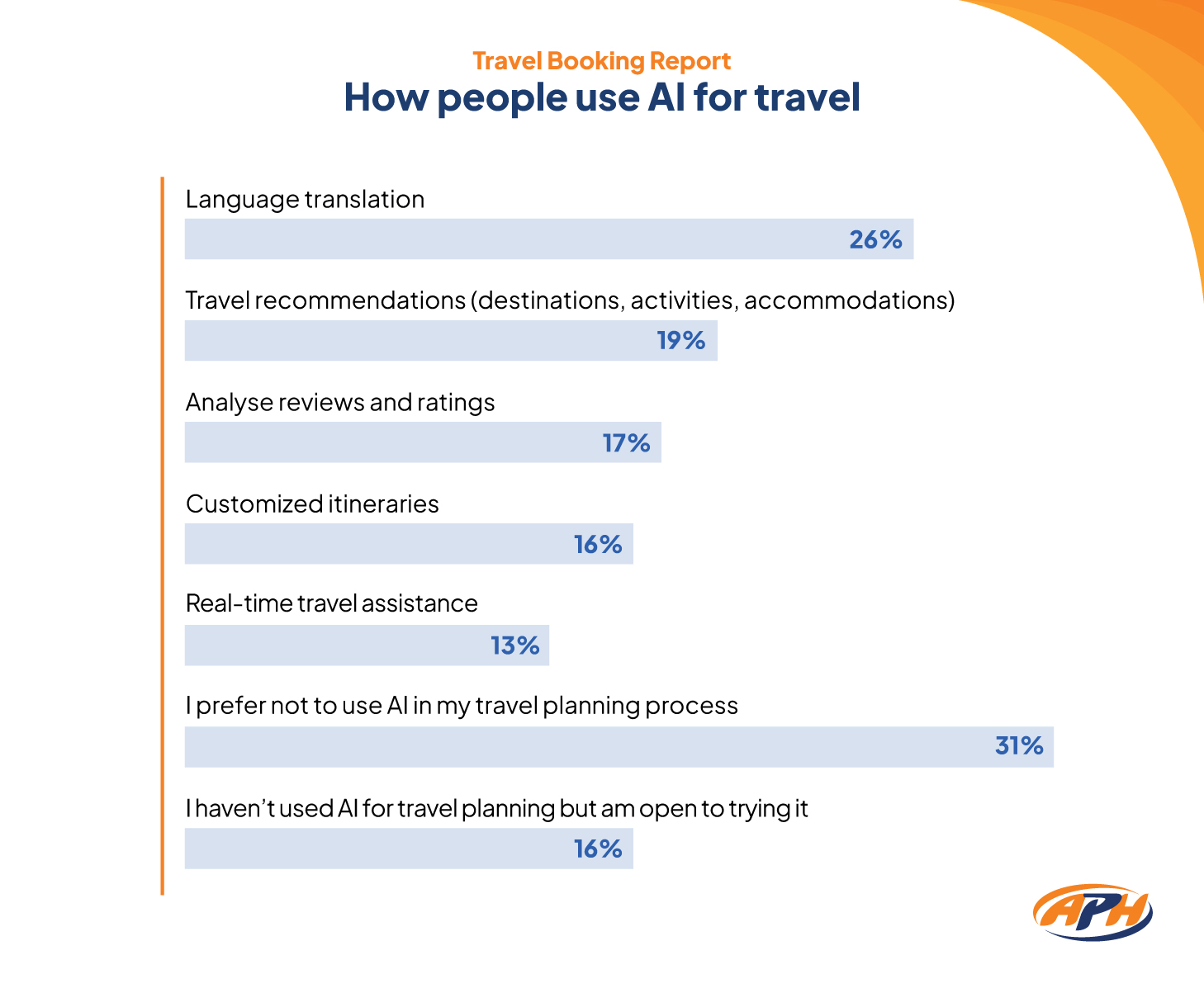
The most common use of AI when it comes to travel experiences is translating languages and communicating with local people (26%). This is followed by finding recommendations for destinations, accommodations and activities (19%), and analysing reviews and ratings (17%).
However, 31% of British travellers said they prefer not to use AI for travel-related purposes, and 16% said they haven’t used it but would be open to trying it.
Source [10]
Conclusion
The travel booking industry is clearly continuing its shift towards digital-first experiences, with online travel agencies dominating the research and booking processes. Booking online provides convenience and can even offer cost savings compared to in-store travel agents.
Alongside this, the role of AI is gaining traction when it comes to planning and booking travel, with the adoption of these tools growing in the last year, though many travellers are still not comfortable using them to plan their trips.
As technology in the travel space continues evolving, providers will need to prioritise seamless digital experiences while also balancing traveller preferences for personalised experiences and the use of emerging tools like AI.
Sources
- Expedia, “Path to Purchase Report 2023” https://partner.expediagroup.com/content/dam/unified/partner/documents/reports/2023-reports/report-path-to-Purchase-2023-final_en-us.pdf
- Grand View Research, “UK Online Travel Booking Service Market” https://www.grandviewresearch.com/horizon/outlook/online-travel-booking-service-market/uk
- Euromonitor, “Revolutionising Travel: ChatGPT and Generative AI” https://www.euromonitor.com/article/revolutionising-travel-chatgpt-and-generative-ai-usher-in-new-era-of-automation
- YouGov, “What Drives UK Holiday Bookings 2025” https://business.yougov.com/content/51067-what-drives-uk-holiday-bookings-in-early-2025
- Hilton, “2024 Trends in Connectivity and Personalization” https://stories.hilton.com/2024trends-connectivity-personalization
- Statista, “Top Travel and Tourism Websites” https://www.statista.com/statistics/1388573/top-travel-tourism-websites-by-monthly-visits/
- YouGov, “Travel Booking Trends: How Far in Advance Brits Plan” https://business.yougov.com/content/50712-travel-booking-trends-how-far-in-advance-do-brits-plan
- YouGov, “Top Booking Factors for UK Travellers” https://business.yougov.com/content/52566-top-booking-factors-for-uk-travellers-and-the-dealbreakers-that-end-a-stay
- Which?, “Is It Cheaper to Book My Holiday Online or With a Travel Agent?” https://www.which.co.uk/news/article/cheapest-way-to-book-holiday-travel-agent-aARlh1F4SEUG
YouGov, “Brits More Comfortable Using AI for Trip Planning Than Last Year” https://business.yougov.com/content/52771-brits-more-comfortable-using-ai-for-trip-planning-than-last-year