
Suffered a puncture recently? It’s likely the spare wheel you found wasn’t what you were expecting… perhaps it wasn’t a wheel at all?
Run Flat tyres
The dreaded moment – having to change a flat tyre on the roadside. If you’ve suffered a puncture recently, you might have popped open your boot to find that the “spare wheel” wasn’t what you expected… in fact, it might not have been a wheel at all! Modern cars increasingly come with so-called “non-standard” solutions instead of a traditional full-size spare. Not knowing the rules for using these alternatives can put your safety at risk and potentially land you with a hefty fine. (Driving on an illegal or unroadworthy tyre – spare or not – can incur up to a £2,500 fine and 3 penalty points per tyre.)
We’re going to explore the new breed of spare-tyre solutions that car manufacturers provide when you suffer a blowout. Read on to learn what type of “spare” your vehicle might have, how long you can use it, and what driving restrictions apply to each.

What Happened to the Good Old Spare Wheel?
There was a time every car came with five identical tyres – four on the road and a full-size spare ready to slot in at the twist of a jack. Those days are fading. With alloy wheels now commonplace (and expensive), plus car makers pushing to save space and weight, the traditional spare wheel has often shrunk to a slimmer substitute or disappeared altogether. In many new models, you’re lucky if you find any kind of spare tyre in the boot.
So, What Are the New “Spare Wheel” Options?
Most modern cars will have one of three solutions in place of an old-school spare tyre:
- Space-saver spare wheel – a compact temporary-use tyre, smaller and thinner than a regular one.
- Tyre sealant and inflator kit – a bottle of sealant “goo” and a compressor to patch the puncture and re-inflate your tyre.
- Run-flat tyres – specially reinforced tyres mounted on the car that can be driven on for a limited distance after a puncture.
Let’s look at each of these in detail and the important rules you need to know for using them safely.
Space-Saver Spare Wheels
A typical space-saver spare wheel is much smaller than a regular tyre. A space-saver wheel is a temporary spare tyre that is significantly thinner (and often smaller in diameter) than your normal tyres. It’s safe to use only if you stick to its limitations. Remember, a space-saver is meant to get you to a place of safety (like the nearest garage) – it’s not meant for daily driving or long trips.
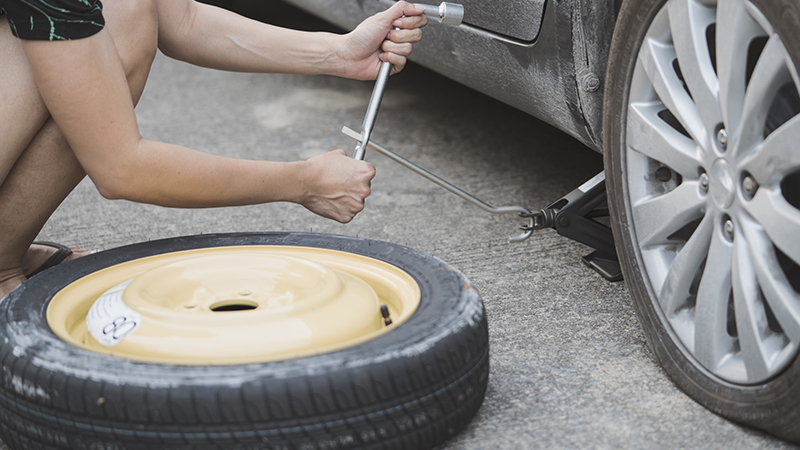
Speed restrictions: Most space-saver spares carry a maximum speed rating of about 50 mph (often indicated on a bright sticker or printed on the wheel). Exceeding 50 mph is dangerous and could even lead to prosecution, because these slim spares dramatically affect your car’s handling and grip. Treat 50 mph as an absolute upper limit – slower is always safer on a spare.
Distance limitations: There’s no hard-and-fast law on how far you can drive on a space-saver, but around 50 miles is generally recommended as the maximum safe distance. The reason is that space-saver tyres have shallow tread and softer rubber, so they wear out much faster than normal tyres. In fact, they often start with only about 3 mm of tread depth (vs. ~8 mm on a new standard tyre). Pushing them too far increases the risk of failure. In short, get your full-sized tyre repaired or replaced as soon as possible – don’t use the skinny spare for longer than necessary.
One at a time: You should never use more than one space-saver wheel on your car at once. Having two undersized spares would be extremely unsafe. Also, check your vehicle’s handbook for placement instructions. Some cars specify that the space-saver should only be used on a particular axle (front or rear) for safety. This can be to avoid interference with braking components or prevent damage to the transmission on certain vehicles. If, for example, you drive a front-wheel-drive car and get a front puncture, the manufacturer might advise fitting the space-saver on the rear and moving a good rear tyre to the front – but always confirm in your manual or with a mechanic.
Handling and safety: Be prepared for your car to feel different with a space-saver on. Because it’s narrower and has less traction, your vehicle’s cornering and braking ability will be reduced. You might experience noticeably less grip – some experts estimate about a 10–15% reduction in cornering grip. The car may also pull or behave unpredictably under hard braking. Allow extra distance for stopping, take corners more slowly, and generally drive cautiously. It’s also wise to avoid motorways if possible when you’re limited to 50 mph. While not illegal, going 50 on a motorway (where lorries are doing 56 mph or more) can create a dangerous speed differential. Stick to back roads or get off at the next exit rather than cruising for miles on a spare.
And one more crucial point: check the spare’s air pressure regularly. Space-saver spares are usually pneumatic (air-filled) tyres just like normal ones, so they can lose pressure over time. The last thing you want is to put on your spare and find out it’s half-flat. An under-inflated space-saver is extremely dangerous to drive on – it could fail outright. So make it a habit to include the spare in your tyre pressure checks.
Legal and MOT notes: All the normal tyre laws (like minimum tread depth) apply to a space-saver when it’s on your car. If the spare is worn beyond legal tread limits (less than 1.6 mm in the UK), it’s an illegal tyre on the road – subject to fines just like any other tyre. However, there’s an exception: if you only have the space-saver fitted in an emergency, it’s tolerated to get you to a repair. Do note, you cannot pass an MOT test with a space-saver tyre on the car. The MOT requires normal tyres on all wheels; a temporary spare on an axle will cause an automatic fail. So, if your MOT is due, ensure you’ve replaced that spare with a proper tyre beforehand.
Verdict: Changing a tyre is becoming a bit of a lost art, but if you’re comfortable with a jack and wheel brace, a space-saver spare wheel is a reliable get-you-home card when you suffer a puncture or blowout. Just remember its limits – slow and steady to the tyre shop, and you’ll avoid turning a quick fix into a major safety hazard.
Tyre Sealant & Inflator Kits
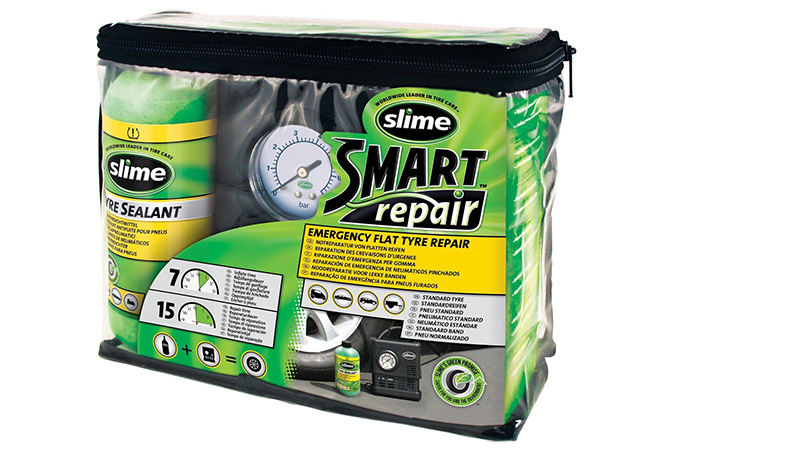
Many new cars include a tyre sealant and inflator kit instead of a physical spare tyre. To save space (and weight and cost), a lot of manufacturers are now providing tyre repair kits in lieu of a spare wheel. These typically consist of an aerosol canister of liquid sealant and a small air compressor or electric inflator. The idea is that if you get a minor puncture, you can inject sealant through the valve into the tyre, plug the leak, and pump the tyre back up – all without ever taking the wheel off the car. It’s a neat, no-hassle concept that can spare you from getting your hands dirty on the side of the road.
Some cars even come pre-treated with a “pre-puncture” sealant already inside the tyres. In those, the sealant automatically tries to seal small holes the moment they occur. The downside is you might not even realise you picked up a nail – your tyre could be losing pressure slowly after the sealant plugs it, so always pay attention to your dashboard tyre pressure warnings if you have this system. (Check your handbook to see if your car has pre-installed sealant, and how to monitor it.)
For most drivers, though, the standard after-puncture sealant kit is what you’ll use. Here’s how it works: you locate the punctured tyre valve, attach the sealant canister (sometimes the sealant and compressor are a single combined unit, other times there’s a separate bottle and a small pump). You press a button or release the canister, which pushes a gunky latex-based fluid into the tyre. This goo circulates inside and plugs the hole from the inside. Then the compressor pumps air through the valve to reinflate the tyre to a drivable pressure. In theory, within a few minutes, you’re back on your way to safety without ever removing the wheel.
It sounds amazing, right? In the best case, it is a quick and convenient fix. However, there are some important caveats and restrictions with sealant kits:
- Limited puncture size: Tyre sealant is really only effective for small punctures (like a typical nail or screw hole). It will not work for a large tear, cut, or blowout where the tyre has shredded. If the tyre’s sidewall is slashed or you have a gaping hole, no amount of goo will save you – and you’ll be stuck waiting for a tow or roadside assistance. In other words, a sealant kit won’t cover every scenario; it’s useless in a major tyre emergency.
- Temporary fix: Even when the sealant seals the puncture, it’s meant to get you to a garage, not to be a permanent repair. Driving on a tyre filled with sealant is a stopgap solution. The chemical plug and air will allow you to limp to the nearest tyre shop, but that tyre will likely need a proper internal patch or replacement soon. Manufacturers generally advise that you should have the tyre professionally repaired or replaced as soon as possible after using a sealant fix. The sealant itself can sometimes make a tyre unrepairable (some types of sealant ruin the tyre interior), so be prepared that you might be buying a new tyre. Think of using the kit as using your spare: it’s just to get you off the road and to help, not to continue your road trip indefinitely.
- Speed and handling: There’s usually no specific speed limit given for driving on a tyre repaired with sealant, unlike the clearly labelled space-saver spares. That said, it’s wise to take it easy. The tyre has been compromised, and even though it’s holding air, it may not cope well with high speeds or aggressive driving. Professionals recommend you drive at moderate speeds and avoid hard acceleration, cornering, or braking after a sealant repair. If the tyre has internal damage, too much stress could cause it to fail suddenly despite the temporary fix. So if you’ve used your kit, turn your hazard lights on if needed, drive at a safe, modest pace, and head straight for a tyre shop.
One more thing: using a sealant kit can be a bit messy, and there’s a chance it won’t even solve the leak if used incorrectly. Always read the instructions before you have a puncture, so you know what to do in the heat of the moment. Some kits have expiration dates too – an old can of sealant might not work when you need it, so consider replacing it periodically (check your car’s manual or the kit instructions for its shelf life).
Verdict: Tyre sealant kits are a handy, user-friendly solution for minor punctures – especially for drivers who aren’t keen on wrenching off lug nuts by the roadside. They save space in the car and can get you moving again quickly. But they’re not a cure-all. A serious tear or total tyre failure will laugh in the face of your little can of sealant, leaving you just as stranded as if you had no spare at all. In short: great to have, but know their limits (and keep your breakdown cover paid up, just in case!).
Run-Flat Tyres
Run-flat tyres are an increasingly popular option, especially on newer or high-end cars. These are tyres built with reinforced sidewalls that can support the vehicle’s weight even with no air pressure. In practice, if a run-flat tyre gets a puncture, you don’t have to pull over immediately – you can keep driving for a while and find a safe place to address it. Sounds perfect for those dark, cold nights when a roadside wheel change is the last thing you want to do, right?
How they work: A run-flat tyre looks almost the same as a normal tyre from the outside, but its construction is tougher. The sidewalls are heavily reinforced with rubber and sometimes other materials. So when the air escapes due to a puncture, the sidewalls don’t collapse, and the tyre doesn’t go completely flat and come off the rim. Instead, it can hold the shape and continue to rotate, albeit with more friction and heat build-up. Essentially, the tyre itself acts as its own support structure (some systems also have an internal support ring). Because of this design, you can maintain control of your car after a puncture – the vehicle won’t suddenly veer as often happens with a blowout on regular tyres. You’ll still need to get the tyre fixed, but you can usually drive yourself to the garage rather than waiting for a tow.
How long and how far: Run-flats are only for temporary extended use – they’re not meant to drive on indefinitely. Each manufacturer sets their own limits, but a common guideline is that you can drive about 50 miles on a punctured run-flat, at speeds up to around 50 mph. This gives you a decent range to find a repair shop or safe stopping point. Some car makers say you can go up to 80 km (50 miles) at 80 km/h (50 mph); others might allow a bit further or require you to stay under ~30 mph – always check your car’s manual and the tyre’s info. Importantly, if you have run-flat tyres, your vehicle must be equipped with a working tyre pressure monitoring system (TPMS). Because run-flats can hold their shape when punctured, you might not notice you’ve lost air just by looking or feeling it immediately. The TPMS will alert you that pressure has dropped. (In fact, in the UK a faulty TPMS can cause an MOT failure, underlining how essential it is for run-flat setups.)
Limitations and downsides: While run-flats offer great convenience and safety in a puncture scenario, they come with trade-offs:
- Ride comfort: Generally, run-flat tyres give a harsher ride than normal tyres. Those stiff reinforced sidewalls that help in a puncture also mean the tyre doesn’t flex as much over bumps. So you might feel more road imperfections, and the car can feel a bit stiffer or noisier on rough roads.
- Handling: In everyday driving (when not punctured), modern run-flats have improved, but some drivers feel they don’t quite match the handling finesse of good standard tyres. The increased rigidity can slightly compromise traction and cornering performance in some situations. It’s a minor issue for most, but if you’re an enthusiast, it’s something to note.
- Cost: Run-flat tyres typically cost more than equivalent regular tyres. They also usually cannot be repaired if punctured in most cases. Once you drive on a run-flat with no air, the internal structure is often damaged beyond what a patch can safely fix. Many tyre shops simply will not attempt to repair a run-flat that’s been driven on flat – the recommendation is replacement. That means even a small nail could mean shelling out for a new tyre, which adds to the expense of using run-flats. (There are rare exceptions where a very minor puncture on a run-flat might be repaired if the tyre didn’t fully deflate, but consider that a bonus, not the norm.) So, running on run-flats can hit your wallet harder over time.
- Availability: Not every garage or tyre retailer stocks a wide range of run-flat sizes, so depending on where you get a flat, you might have to wait for a replacement tyre to be ordered. This is improving as they become more common, but it’s still something to keep in mind – your 50-mile limping range won’t help if the nearest shop doesn’t have your tyre and you have to wait overnight for one.
Verdict: Run-flat tyres are a compelling solution if you value not being stranded by a puncture. If money isn’t a huge concern and you prioritize convenience, they can make a lot of sense – no need to carry a spare wheel or fiddle with sealants on the roadside. Many drivers enjoy the peace of mind they offer. However, be aware of the compromises: you might pay more upfront, feel the road a bit more, and you’ll likely be buying a new tyre every time one gets a puncture. It’s all about what suits your needs and comfort level. For some, the trade-off is worth it for the safety net run-flats provide; for others, a traditional spare (or calling breakdown service) might be just fine.
Bottom Line: Whatever spare solution your car uses – be it a skinny space-saver, a can of tyre sealant, or fancy run-flat tyres – make sure you know the do’s and don’ts before you end up in an emergency. Drive within the limits of the spare, get the original tyre fixed or replaced as soon as possible, and always keep an eye on the condition (and pressure) of your spare or tyres. By following the guidelines above, you can stay safe and avoid turning a simple puncture into a costly ticket or a dangerous situation on the road. Happy (and safe) motoring!
Spare Wheel & Puncture FAQs
Yes – but only temporarily. Space-saver wheels are legal for emergency use, provided you follow the manufacturer’s restrictions. This usually means keeping your speed to 50mph or less and using it only to get to a place of safety or a tyre repair centre. Driving normally or for extended distances could be unsafe and may lead to penalties.
here’s no official legal limit, but most experts recommend no more than 50 miles. Space-saver tyres have reduced grip and shallower tread, so they wear much faster than standard tyres. The sooner you replace it with a full-size tyre, the better.
You can – if the puncture is minor. Tyre sealant kits work well for small holes caused by nails or screws. However, they won’t help with large tears, sidewall damage, or blowouts. Think of them as a short-term fix, not a permanent repair.
It’s not illegal, but it’s strongly discouraged. With a 50mph speed limit, you could become a hazard to faster-moving traffic, particularly HGVs. If possible, avoid motorways altogether and stick to slower roads until your tyre is replaced.
No. A car will fail its MOT if a space-saver wheel is fitted, as tyres of the same size and type must be installed on each axle. If you’ve used a sealant kit or run-flat tyre after a puncture, make sure the tyre is professionally inspected or replaced before the test.