

Luggage going through an airport X-ray screening. (Advanced CT scanners at some UK airports now allow liquids and electronics to remain in bags).

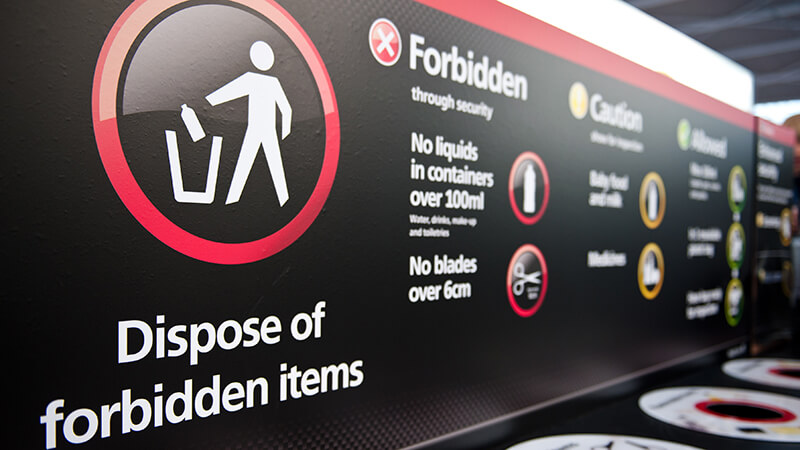
Before you jet off on holiday, make sure you’re up to date with the latest airport security regulations (as of 2025). From the infamous liquids rule to travelling with electronics, baby food, medication, and even sports gear, knowing what you can (and can’t) pack will save you time and stress at the airport. Security staff will stop anything they consider dangerous, even if it might normally be allowed – so it’s crucial to pack smart and comply with current rules. Below is an at-a-glance guide covering all the essentials – read on, and don’t get caught out at the security gate!
Liquids in Hand Luggage
The rules around liquids in cabin baggage have been in place since 2006, and most UK airports still enforce them strictly. In general, you cannot take liquids in containers larger than 100ml through security (even if the container is only part full). All liquid containers must fit in a single clear, resealable plastic bag about 20×20 cm, with a maximum capacity of 1 litre. You’re limited to one such bag per passenger, and you must present it separately for inspection at the security checkpoint. (At some airports with newer scanners, you might not need to remove it, but it’s best to be prepared to do so.)
What counts as “liquids”? It’s broader than you might think. The UK government defines liquids to include all drinks (water, juice, etc.), semi-liquid foods (soups, jams, honey, syrups), cosmetics and toiletries (creams, lotions, oils, perfumes, mascara, lip gloss), sprays (shaving foam, hairspray, spray deodorant), pastes (toothpaste), gels (hair gel, shower gel), contact lens solution, and any other items of similar consistency. Essentially, if it’s not solid, it likely falls under the liquids rule. Frozen liquids count as liquids too, so you can’t bring ice or frozen gels through security – if they’re solid when frozen but could melt, they’re not allowed in hand luggage.
Packing liquids: If possible, pack your liquids in checked luggage to avoid the hassle. But if you do need some in the cabin (maybe a little hand sanitiser or your favourite lip gloss), use travel-size bottles (100ml or under) and put them in that clear zip-top bag. Make sure the bag isn’t overstuffed – it must close completely and not be tied off.
Exemptions to the 100ml rule: There are a few important exceptions where you’re allowed to carry liquids over 100ml in your hand luggage. These include:
- Baby food or milk for your infant (see the next section for details).
- Essential medicines in liquid form, or liquid dietary foods you need for a medical condition. (You should have proof such as a prescription or doctor’s note for these).
- Special dietary liquids that you need for your journey (for example, liquid nutrition for medical reasons).
Even in these cases, take only what you need for the journey. You can bring containers larger than 100ml for these purposes, up to 2 litres per container under UK rules, but you must declare them at security. Security officers might open and test these liquids by sampling or screening them, so allow a bit of extra time for that. It’s wise to have medications and special foods easily accessible for inspection.
Duty-free liquids: What if you buy a big bottle of whisky or perfume in a duty-free shop and have a connecting flight? Liquids purchased after the security checkpoint (duty-free shops or on the plane) are allowed in larger volumes, but they must remain sealed in the special tamper-evident bag with the receipt showing. Don’t open that bag until you reach your final destination, especially if you have to go through security again during a connection. If you do, the item may be confiscated during transit security checks.
New changes coming: You may have heard news about the UK phasing out the 100ml rule. Here’s the latest: some airports have begun installing advanced 3D CT scanners that can screen baggage in more detail. At those airports, you no longer need to take liquids out of your bag, and in some cases, the 100ml limit is being raised to 2 litres! For example, London City Airport was the first to drop the 100ml limit (now allowing up to 2L) in early 2023, and by mid-2025, Birmingham and Edinburgh had also lifted the limit to 2L thanks to new scanners. However, not all UK airports have this technology yet, and some larger airports (Heathrow, Manchester, etc.) are still in the process of implementation. The government’s deadline for major UK airports to upgrade scanners is mid-2024, but a few airports had to roll back the new rules temporarily due to technical glitches. Bottom line: Check the security rules for your specific departure airport before you fly. If in doubt, assume the old 100ml rule still applies to avoid any trouble. And remember, even once UK airports universally relax the liquid rules, many other countries still have 100ml limits – so if you’re flying abroad, the rules on liquids may be different when you come home or if you’re transiting elsewhere.
Baby Food and Baby Milk
Travelling with a baby in tow? The good news is baby food, formula, milk and sterilised water are all permitted in hand luggage, with special exemptions from the 100ml rule. Parents can carry enough for the journey – there is no strict legal volume limit for baby essentials; you’re allowed to bring what you reasonably need for the flight. This includes breast milk, formula, cow’s milk, boiled water for formula (must be in a baby bottle), baby food purees, and cooling gel packs to keep items cold.
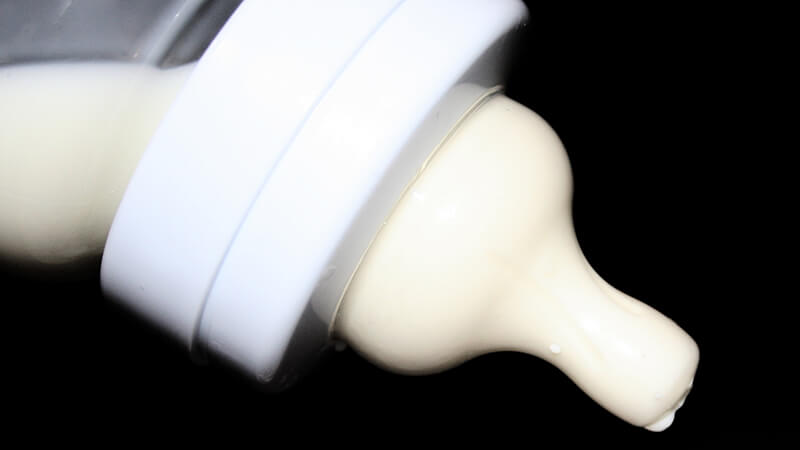
A few important points to ensure a smooth experience:
- If you’re carrying breast milk (expressed milk), you can bring it even if you are not travelling with your infant. Each container of breast milk can be up to 2,000ml (2 litres) in size. You cannot, however, bring frozen breast milk in your hand luggage – frozen milk must stay in the hold (or be left at home). Unfrozen liquid breast milk is fine up to 2L per container.
- For formula, cow’s milk, and other baby food/liquids, if you are travelling with your baby, you’re allowed to carry them in hand luggage in quantities greater than 100ml. The UK rules specifically say “baby must be present” for these items to be allowed in larger quantities. (Security might reasonably question an adult with litres of baby formula and no baby!)
- You do not have to fit baby liquids into the 20cm plastic bag – baby food and milk are exempt from that and can be packed separately. But do pack them so they are easy to pull out for inspection. All baby foods and liquids must be presented at security and will likely be screened separately. Security officers may ask you to open containers and possibly even taste or test the baby food/milk to prove it’s safe. This is normal – they have special equipment to test liquids. Just be prepared: if you’ve carefully warmed a bottle for your little one, you might have to open it at the checkpoint, so you might need to re-warm it later.
Here’s a quick reference from the UK guidelines:
- Breast milk – Allowed in hand luggage (in containers up to 2L each) whether or not the baby is with you. Frozen breast milk is not allowed in hand luggage (pack frozen milk in the hold). Allowed in hold luggage too.
- Formula milk, cow’s milk (for baby) – Allowed in hand luggage if baby is travelling with you (no 100ml limit), and also allowed in checked luggage.
- Sterilised water (for mixing formula) – Allowed in hand luggage in baby’s bottle (baby must be present). Allowed in hold luggage too.
- Soya milk for babies, baby food (purees, pouches) – Allowed in hand luggage if baby is with you, no 100ml limit. Both are fine in the hold as well.
- Gel or ice packs to keep baby food cool – Allowed in hand luggage (and hold) as they are for a medical/dietary purpose.
Please note that the normal liquid bag rules do not apply to these baby items, but it’s wise to pack them together and inform the security officer that you have baby food/milk. They deal with this all the time. You might say, “I have baby formula and food in this bag that may need special screening,” and they’ll direct you. Every container may be scanned or opened for testing, which can take a few extra minutes, so plan for that when budgeting time to get through security.
One more tip: carry baby supplies in the original containers if possible (factory-sealed jars, sealed formula cans, etc., or pre-measured powder formula in a dispenser). While not required, it can help security officers quickly identify the items. And having a baby with you (or all the baby paraphernalia) will make it obvious why you’re carrying liquids over the limit!
Lighters
Smokers, take note: you are allowed to carry one disposable lighter on your person when you fly, but the rules are a bit quirky. Here’s the breakdown:
- Only one lighter per passenger is permitted, and it must be kept in your hand luggage or on your person through security. In practice, the UK rule is to place your lighter in a clear resealable plastic bag (like the liquids bag), then keep that bag on your person (in your pocket) once you’ve gone through security. The lighter should not go back into your carry-on after screening – it should remain with you (e.g. in your pocket) for the flight. This is to ensure it’s accounted for and not accidentally left loose in the cabin or in the overheads.
- You cannot pack lighters in checked baggage, period. And you shouldn’t pack your lighter inside your hand luggage after security either (security will usually remind you to carry it on you).
- Lighter fuel and lighter refills (like butane canisters) are completely forbidden in both hold and hand luggage. Don’t even think about bringing that big can of lighter fluid or extra butane cartridges – they will be confiscated, as they pose a fire risk.
- If you have a special lighter (e.g., a fancy Zippo or a butane jet lighter), note that certain types of lighters are banned entirely: “strike anywhere” Zippo-style lighters with unabsorbed fuel may be denied. The general allowance is for a typical disposable lighter or a Zippo that is fully absorbed in its cotton (no liquid fuel sloshing around). Torch lighters, jet flame lighters, and chef’s torches are usually not allowed, even if it’s the only one you carry, because they burn hotter and pose more risk – many airlines follow the rule of prohibiting those high-powered lighters. When in doubt, a basic Bic-style disposable lighter is your safest bet for travel.
- And needless to say, smoking on the plane is illegal, and that includes trying to sneak a vape or light anything. Your lighter is just for your convenience at the destination – do not use it during the flight.
So, if you must travel with a lighter: pack just one, put it in the liquids bag for screening, then slip it in your pocket. All other lighters should be left at home or will be tossed by security. Safety matches (one small pack) are an alternative – see “Personal Items” below for match rules – but only “safety” matches are allowed, and even then, only on your person, not in your bag.
Mobility Aids
For passengers with disabilities or mobility needs – or even parents with strollers – rest assured that mobility aids are generally allowed through security and in the cabin, with some conditions:
- Items like walking canes, crutches, foldable walkers/rollators, and compact wheelchairs are usually permitted right up to the aircraft door. They do need to go through X-ray screening or be inspected just like any other item, so you’ll place canes or crutches on the belt for the scanner. Wheelchairs and larger aids will be screened by alternative methods (swabbing for traces, visual inspection, etc.) if they don’t fit the X-ray. Security may assist you if you need to be temporarily separated from your device for screening.
- Strollers/Pushchairs for infants: You can typically take a buggy or pushchair to the gate. At security, you’ll often be asked to collapse it and put it through the X-ray machine (if it fits) or have it inspected. Many airports then tag the stroller for gate-check (so it goes in the hold for the flight and is returned to you upon landing). The security regulation side is no problem – strollers are allowed; it’s airlines that set rules on how far you can take them (usually to the gate is fine). Just remember to retrieve it after the X-ray.
- Wheelchairs and electric mobility aids: You absolutely can travel with these, but if you have a battery-powered wheelchair or scooter, you must contact your airline in advance – preferably at least 48 hours before travel. The airline will need details about the battery type (spillable lead-acid, non-spillable, lithium-ion, etc.) and will have procedures to stow or secure the device. For example, airlines typically remove or disconnect the battery and carry it safely, or ensure the chair’s power is disabled for the flight. There are limits on lithium battery sizes for mobility devices (usually 300 Wh maximum for lithium, and you can have a spare battery if under 300 Wh or two spares if each is under 160 Wh). This is all to prevent any chance of battery fire in the hold. The key point: coordinate with your airline – they’ll guide you through the process. At security, battery-powered chairs will undergo special screening, and you should arrive early. Security staff may inspect the chair and swab it for explosives (this is routine).
- Other medical devices like CPAP machines, TENS units, portable concentrators: these are allowed in the cabin (and often don’t count against hand baggage limits if needed for medical reasons – check with airline). They will be screened; you can request that they not be X-rayed if you have concerns, but generally, it’s safe for the device. You might want to carry a doctor’s note for such equipment just in case, but it’s not strictly required for security – more for airline approval.
- To summarise: mobility aids and medical equipment are accommodated. Pushchairs, canes, walkers – all fine in the cabin after screening. Large items like wheelchairs might be taken into the cabin if collapsible, or placed in the hold, but you can use them to reach the plane in most cases. Just ensure you’ve communicated with your airline for anything powered or unusually large/heavy. Security will screen everything but won’t refuse these aids. Your airline and airport staff can provide assistance through security if needed.
Personal Items: What Goes in Hand Luggage vs Hold
Ever wonder if you can bring your knitting needles on board? Or what about that corkscrew souvenir? Here’s a quick rundown of common personal items and whether they’re allowed in your hand luggage (cabin) or must go in hold luggage:
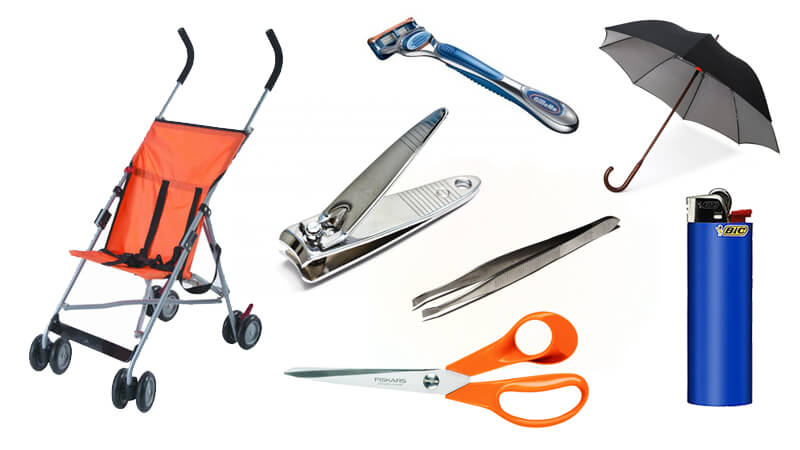
Allowed in Hand Luggage: You might be surprised, but many everyday items are permitted through security. For example:
- Eating utensils: Forks and spoons – yes, you can bring a spoon or fork (plastic or metal) in your carry-on. A standard table knife (butter knife with blunt edge) is usually okay too, though sharp knives are not (see below).
- Small scissors – if the blades are 6cm or less (about 2.5 inches) measured from the pivot, these are allowed in hand luggage. Small craft scissors or nail scissors typically qualify. Round-ended (blunt tip) scissors of any length are also allowed, since they can’t stab.
- Nail care items: Nail clippers and nail files, yes – these are fine in the cabin. Tweezers, also fine. A basic disposable razor (the kind with a fixed cartridge blade) is allowed as well. Those razor cartridges are enclosed and not seen as a security risk. (However, a loose razor blade by itself – like the kind you put in an old-fashioned safety razor – would not be allowed in hand luggage.)
- Sewing and knitting supplies: Good news for crafters – knitting needles are allowed in hand luggage. Regular sewing needles/pins are allowed, too. It’s wise to package them safely (e.g. in a needle case) so you don’t accidentally poke yourself – or a TSA officer – during inspection. But they’re not prohibited.
- Umbrellas – yes, you can carry an umbrella on the plane (just no sharp tips – most umbrellas are rounded).
- Walking stick/cane – yes, allowed in cabin (as mentioned under mobility aids). It will be screened, but you can take it with you.
- Safety matches – you can bring one small packet of safety matches on your person (not in your carry-on). “Safety” matches are the normal kind that only strike on the strip of the matchbox. You cannot bring the more hazardous “strike anywhere” matches at all. And you cannot pack any matches in checked luggage (fire hazard). So one little matchbox, on your person, is okay.
- Contact lens solution – treated like any liquid: you’re allowed up to 100ml in hand baggage. A larger bottle should go in the hold or be packed in smaller bottles to carry on.
- Electronics – phones, tablets, laptops, cameras, etc., are allowed in hand luggage (more on that later).
- Books, toys, games – of course, those are fine (just nothing that looks like a weapon or bomb – e.g. a toy gun is a no-go in hand baggage, it would need to be in hold or not at all).
Not Allowed in Hand Luggage (but OK in Hold): These are the items you must pack in your checked baggage if you want to take them, because they will be confiscated by security if found in your carry-on. Many are sharp objects or tools:
- Knives or knife-like items: Any knife with a blade longer than 6cm or that has a sharp point is not allowed in the cabin. This includes chef’s knives, hunting knives, pocket knives, and souvenir blades. If the blade is 6cm or less and not lockable, some small pocket knives might pass, but as a rule, security tends to confiscate knives, so it’s better to just put all knives in the hold (or leave them). Also, razor blades not in cartridges (like utility knife blades or the removable blades for straight razors) are not allowed in hand luggage.
- Large scissors: If the blades are longer than 6cm, they can’t go in hand baggage. So your full-size paper scissors or kitchen shears – those need to go in checked.
- Corkscrews: A classic “can I bring it?” item – the answer is No for hand luggage if it has a metal pointed end (which most do). Corkscrews have a sharp point and often a small blade for the foil; security will take it. Pack it in your suitcase instead.
- Sporting bats/clubs: (More on sports equipment later, but generally any kind of bat, club, or stick used for sports is not allowed in the cabin because it can be used as a weapon.) For personal items, this might cover things like a walking hiking pole – trekking poles have a spike and are not allowed in the cabin; put them in the hold.
- Work tools: Any tools, like screwdrivers, wrenches, pliers, etc., are not allowed in hand baggage – we have a dedicated section on tools below. Even small ones usually get flagged (a tiny eyeglass screwdriver might pass, but we wouldn’t risk it – security has discretion to say no).
- Blunt instruments: This is broad, but if something can be used to hit someone (and isn’t obviously a harmless item like an umbrella), security might forbid it. E.g., a heavy maglite flashlight longer than 6 inches might get scrutiny (technically not on the prohibited list, but could be seen as a clubbing item). Musical instruments like a guitar are allowed, but something like a steel string could be used dangerously (though they don’t prohibit guitar strings explicitly). Use common sense here.
- Lighter fuel, refills, butane – as mentioned, strictly not in cabin or hold. Only the one permitted lighter (with fuel in it) is allowed on person. So any spare fuel must stay behind.
- Non-safety matches: “Strike anywhere” matches (the kind that can ignite from friction on any surface) are forbidden entirely – neither in hand luggage nor hold. They pose too great a fire risk. Do not bring them at all.
Basically, if it’s sharp, pointy, or could be used to harm someone, plan to pack it in the checked luggage. Security agents have some latitude; they can confiscate any item they deem dangerous, even if it’s not explicitly on a list. For instance, a metal comb with a pointed handle might be seen as a potential weapon. It’s rare, but keep it in mind – if something looks menacing, they may take it.
Not Allowed at All (Prohibited in both Cabin and Hold): Certain items can’t be taken on the plane at all, in any luggage. We’ll cover many under “Chemicals and toxic substances” and “Ammunition” below. But as a preview, this includes things like fireworks, flares, gunpowder, mace/pepper spray, explosives, etc. – these are obviously no-gos. Also, personal defence items like stun guns or brass knuckles are typically prohibited in the cabin and often in the hold too. If you have doubts about a specific odd item, check the gov.uk guidance or your airline.
For quick reference, here’s a mini-table for some personal items (hand luggage “Yes/No”):
- Corkscrew: Hand Luggage – No, Hold – Yes.
- Small Scissors (≤6cm blade): Hand – Yes, Hold – Yes.
- Large Scissors (>6cm): Hand – No, Hold – Yes (but check airline if extremely large).
- Knife (sharp or pointed, blade >6cm): Hand – No, Hold – Yes (securely wrapped).
- Pocket knife (blade ≤6cm): Technically could be Yes, but many airports will confiscate anyway unless it’s very small. When in doubt – No for cabin.
- Disposable Razor: Hand – Yes, Hold – Yes.
- Nail Clippers/File: Hand – Yes, Hold – Yes.
- Tweezers: Hand – Yes, Hold – Yes.
- Knitting/Sewing Needles: Hand – Yes, Hold – Yes.
- Umbrella: Hand – Yes, Hold – Yes.
- Walking Cane: Hand – Yes, Hold – Yes.
- Stroller/Pushchair: Hand – Yes (to gate), Hold – Yes (usually gate-checked).
- Wheelchair: Hand – Yes (to aircraft door), Hold – Yes.
- Safety Matches (one small pack): Hand – Yes (on person), Hold – No.
- Lighter: Hand – No (in bag), but Yes on person (one only) – Hold – No.
- Non-safety Matches: Hand – No, Hold – No.
- Fireworks/Firecrackers: Hand – No, Hold – No.
If you’re ever unsure, the UK government’s online tool and list is very handy – but the above covers most questions. When packing, it can also help to ask yourself: Do I really need this in the cabin? If not, play it safe and stick it in the checked bag. Better to arrive with it in your suitcase than have it tossed in the airport bin by security.
Essential Medications and Medical Equipment
Many of us need to travel with medications or medical supplies. The authorities understand this, so there are accommodations in place. Essential medicines (and related medical items) are allowed in your hand luggage, even if they exceed the normal 100ml liquid limit, but there are some important steps to follow:
- Prescription Medicines (liquids over 100ml): You can bring liquid medications larger than 100ml in your carry-on if they are truly needed for your journey. This includes things like liquid prescription drugs, IV fluids, special liquid food for dietary needs, or medical inhalers/nebuliser solutions. However, if a liquid medicine exceeds 100ml, you should carry proof that it’s prescribed to you – for example, a doctor’s letter or a copy of the prescription with your name on it. The UK rules state that for liquid meds over 100ml, security may ask for evidence of medical necessity. In practice, they don’t always ask, but it’s wise to have it. The letter/prescription helps verify why you have a big bottle of liquid. (Note: If it’s a smaller bottle – 100ml or less – and it’s not obviously a med, it can just go in your liquids bag. Pills or insulin vials, etc., under 100ml don’t require any proof by security, but having your prescription info is still a good idea for customs or if questioned.
- Quantity: You’re allowed to bring enough medication for your trip’s duration (plus a bit extra in case of delays, usually recommended). If this means more than 100ml of a liquid, that’s fine. But if you needed, say, 2 litres of a medical liquid, that might raise eyebrows – so get confirmation from the airline or airport in advance in such edge cases. Generally, “enough for the journey” is interpreted reasonably – e.g., a 500ml bottle of chemo drugs or a week’s worth of tube feeding liquid, etc., have been allowed. Check with the airport in advance if you have an unusually large volume of medical liquids, just to be safe.
- Medical Equipment: Items like EpiPens, insulin pens, syringes, CPAP machines, portable oxygen concentrators, blood glucose monitors, etc., are all allowed in the cabin. If you need needles (syringes) for medical reasons, you can bring them – but it’s good to have a doctor’s note or prescription for those as well, to show security why you have needles. Pack your insulin or other injectables in your hand luggage (don’t put insulin in the hold; it can freeze). Security is used to seeing these; just declare them if the X-ray looks confusing.
- Screening of Medicines: All medications will still go through security screening. Pills can just go through X-ray in your bag. Liquid medicines over 100ml should be taken out and shown separately. They might put larger liquid meds through a special scanner or simply do a quick test (they have devices that can confirm if a liquid is benign without opening it, in many cases). Airport staff might ask to open a container for testing – for example, they might dip a test strip into a liquid or just visually inspect it. It helps if labels are intact on your medicine bottles to identify them. If you prefer they not open something (maybe it’s sterile), tell them, and they can use alternate tests or swabs on the outside.
- Solid Medications: Tablets and capsules are easy – they are allowed with no quantity limit. You do not need to show documentation for pills, but again, having them in original packaging and carrying a copy of your prescription is smart, especially when travelling internationally (for customs or if you need refills). The UK security won’t hassle you about a bunch of pills as long as they don’t suspect it’s illegal drugs.
- Where to pack meds: Always pack critical medicine in your hand luggage, not in checked. If your checked bag goes missing, you don’t want to be without medicine. Airlines generally permit an extra small bag for medical supplies in the cabin if needed – check with them, but most are accommodating for medical equipment. For instance, if you have a CPAP machine, many airlines don’t count it toward your hand baggage allowance, but you might need to tell them in advance.
- Doctor’s Letter: The advice is to get a doctor’s note for your medications and equipment, especially if over 100ml or if you have injectable meds. Many doctors have form letters for this. They may charge a small fee for writing it, but it can be worth it. The letter should state your name, what medications/equipment you need to have with you, and that it’s for personal medical use. Security may ask for this for liquids over 100ml, and airlines might ask if you’re bringing things like a nebuliser or oxygen. Plan ahead – request any letters at least two weeks before travel.
- Original Packaging: It’s recommended to keep medications in their original pharmacy packaging with labels. Loose pills in a ziplock can arouse suspicion (what are these unidentified pills?). Labelled prescription bottles or blister packs with a script are much better. If you transfer some into a pill organiser for convenience, also carry the original labelled bottle or a copy of the prescription to prove what it is, in case you’re asked.
- Equipment requiring power: If you have a battery-operated medical device (like a portable oxygen concentrator or nebuliser), ensure it meets airline regulations (most do). Spare batteries for these should be in carry-on (lithium battery rules apply – usually under 100 Wh is fine, above that you may need airline approval). And definitely inform the airline if you need to use something like oxygen on board – they often have their own procedures (e.g., some require you to use airline-provided oxygen rather than your own tanks).
- Cooling packs: If your medicine needs to be kept cool (e.g., insulin), you can carry cool gel packs or even small ice packs. Those are allowed through security if they are needed to keep medicine at the right temperature. They might scrutinise the gel pack, but explain, and they generally allow it (they may need to be satisfied it’s for medical use – storing it with the meds helps make the case). Some gel packs could partially melt and become liquid; because they’re for medical purposes, they can be exempt from the 100ml rule when used this way.
- Sharp containers: If you will need to dispose of needles on the journey, bring a little travel sharps container. You can actually request one from the airline sometimes. It’s not a security requirement but just a safe practice.
The UK government’s at-a-glance table confirms that basically all essential meds and equipment are allowed in both hand and hold luggage (with the caveat that oxygen cylinders usually require airline approval and might not be allowed unless provided by the airline). For example: tablets, injectors, EpiPens, insulin pens, syringes – Yes in hand luggage. You can even bring your CPAP machine or TENS unit in hand luggage – Yes. An important note: If your medical gear plus luggage exceeds the airline’s carry-on size/weight limits, contact the airline – most will make an exception or advise you to carry an extra small bag for it. They won’t force you to put life-critical items in the hold just to satisfy a weight limit, but you should clear it with them.
Finally, if you have any doubts or extraordinary circumstances (say, travelling with an organ for transplant – that has happened!), call the airport or airline’s special assistance line ahead of time. But for the average traveller with prescription meds: keep them with you, have paperwork for anything unusual, and you’ll be fine. Security sees thousands of medications daily.
Electronic Devices
These days, everyone carries a small tech arsenal when traveling – smartphones, earbuds, laptops, tablets, cameras, e-readers, etc. Airport security rules absolutely allow these in your hand luggage, but there are a few important things to know to avoid problems.
What electronics can you bring on? Pretty much all personal consumer electronic devices are allowed in both hand and hold luggage. The UK guideline specifically lists mobile phones, laptops, tablets, MP3 players, hairdryers or straighteners, travel irons, and electric shavers – all allowed in cabin and hold. Cameras and camera equipment are usually fine in both as well (though very large professional video equipment might need prior arrangement). One thing to note: E-cigarettes (vapes) are not allowed in checked luggage due to fire risk; they can only travel in hand luggage (and you must not use them on the plane). So if you vape, keep your e-cig and spare lithium batteries for it in your carry-on.
Take devices out or not? At traditional airports, the standard procedure has been to take out laptops, tablets, and large electronics from your bag and put them in a separate tray for X-ray screening. This helps the security officer get a clearer look (since dense electronics can obscure other items in the bag). However, as mentioned earlier, some UK airports now have new 3D scanners that do not require you to remove electronics. The government is aiming for a 2024 rollout of these, but it’s not everywhere yet. So, what should you do? When you approach the X-ray, listen to the staff’s instructions. They will usually say something like “Laptops out, tablets out, keep phones and smaller electronics in bag.” Follow whatever the rule is at that airport on that day. If unsure, it doesn’t hurt to take them out preemptively, except perhaps at the new scanners where they might tell you “you can leave everything in your bag.” Airports with advanced scanners (like London City, Birmingham, Edinburgh, etc.) now often allow you to leave laptops in your bag. But e.g. at Heathrow or many others, you still need to pull them out. Always double-check the signage or ask an officer if you’re not certain. The transition period could be confusing.
Powering on devices: A critical rule introduced in 2014 and still in effect – your electronic devices must be charged enough to power on if asked. Security officers (or sometimes boarding gate staff for flights to certain destinations) might ask you to turn on your phone or laptop. This is to prove the device is real and not a shell hiding something else. If your device is completely dead (battery empty) and you cannot turn it on when requested, it may not be allowed on board. In the worst case, you might have to leave the device behind or even miss your flight. So take this seriously: charge your important devices before coming to the airport.
What happens if you’re selected and your device won’t turn on? Different airlines have had different policies: for instance, British Airways stated they could ship the device to an address for you (at their cost) so you can still fly without it. Virgin Atlantic said similar. Some airlines might let you rebook to a later flight after you’ve charged the device. Others (especially U.S. carriers) have indicated they’d just make you ditch the item or miss the flight. The Department for Transport’s stance is clear: a device that can’t be powered on is not allowed in the cabin. So don’t count on mercy. Be proactive: if your phone is low on battery as you queue for security, switch it off to save juice, or use a portable charger if you have one (see our battery tips section below for more on this). Many airports have charging kiosks or outlets near security or gates – you could ask an officer if you can plug in for a moment if needed. But it’s best not to get into that situation.
Tip: If you do accidentally have a dead device, sometimes security might allow you to go charge it and come back, but this is at their discretion and time permitting. Heathrow, for example, installed some charging stations at gates for this reason. But with tight flight timelines, you might not have time. So again – charge devices or at least have them at 30%+ before security.
Spare batteries and power banks: These fall under both security and safety rules. Spare lithium batteries (like camera batteries, drone batteries, or power banks) are NOT allowed in checked baggage due to fire risk. You must carry them in the cabin. Usually, you can bring up to two spare batteries if they are large (100-160 Wh each), or more if smaller (like phone size). Most power banks are under 100 Wh, which is fine. Keep them in your hand luggage. Security is mainly concerned that they’re not loose and shorting – so tape over the contacts or keep each battery in a protective case or plastic bag to prevent short-circuits. This is more of an airline safety rule, but security might enforce it if they see a big battery in your bag – they might ask if it’s a power bank (which is okay in the cabin) versus in hold (not okay). If you have an electric scooter or something with a lithium battery, that’s a whole other issue – check with the airline. But spare batteries for consumer electronics – cabin only. Also, most airlines limit lithium metal (non-rechargeable) batteries to 2 grams of lithium per battery (covers AA/AAA etc., no issue) and lithium-ion to 100 Wh without approval.


In-flight use considerations: Not a security issue, but note that you can’t use certain devices at takeoff/landing (flight mode rules) and absolutely no phone calls in flight (currently). Also, if you have a Bluetooth tracker in a checked bag (like an AirTag), that’s allowed by security and airlines – no need to remove those.
Packing electronics securely: From a security standpoint, they don’t care how you pack it, but from practical view, put your laptop in an easy-to-remove sleeve, coil your charging cables neatly (loose wires can look suspicious on X-ray), and maybe avoid clutter – a bag stuffed with tangled electronics might earn a manual search simply because it’s hard to decipher on X-ray.
One more thing – data: This is beyond security rules, but crossing some borders (like the US) can sometimes involve device searches. Just be aware of the laws of your destination about encrypted devices or such. The UK generally doesn’t search device content for routine travellers, but if you’re transiting via places with strict rules, it’s worth noting.
In summary: Electronic devices are welcome in your carry-on, just keep them charged and be ready to demonstrate they work. Remove them at security if asked. And don’t pack things like loose batteries in hold. Treat your gadgets with care on the journey – security will. As the UK government puts it: if your device does not switch on when requested, you will not be allowed to take it onto the aircraft. So charge up and game on (at 30,000 feet).
Sports Equipment
Heading off on a ski trip, golf weekend, or planning to play tennis on holiday? Traveling with sports gear is common, and you can definitely do it – but most sports equipment cannot be carried in the cabin (hand luggage) if it’s large or could be used as a weapon. Here’s what you need to know about various sports items:
- Items Allowed in Hand Luggage: The general rule is that if it’s small, not too hard or pointy, and not likely to be used to hurt someone, it might be allowed in the cabin. According to UK guidelines, a sports parachute (like a folded parachute for skydiving) is actually allowed in both hand and hold luggage – presumably, a parachute is just fabric. Also, interestingly, tennis racquets are allowed in hand luggage. Tennis rackets often fall within carry-on size, and security permits them, despite them being somewhat hefty; check with your airline on size, but security-wise, they’re listed as okay. Likewise, snooker, pool, and billiard cues are allowed in hand luggage under UK rules now. This might surprise some (a pool cue could be a weapon), but as of the latest guidance, it’s on the “allowed” list for cabin – possibly because cues separate into two pieces, and individually they seem less threatening. However, I’d caution that some security staff might question a cue – the official stance is yes, it can be hand-carried (and I have personally carried snooker cues on board before without issue). Fishing rods are also shown as allowed in hand luggage – presumably collapsible ones that fit in the cabin. If you have a 7-foot one-piece rod, obviously that won’t fit in the cabin, and the airline wouldn’t allow it as carry-on due to length, even if security doesn’t forbid it. So dimension-wise, you have to comply with airline size restrictions too. Sports parachutes, racquets, cues, fishing rods (collapsible) – these are the main ones explicitly allowed for cabin in guidelines.
- Items Not Allowed in Hand Luggage (but OK in Hold): Many sports items are too dangerous or bulky for cabin and thus must go in the hold. Here are examples and essentially it’s anything heavy or that could be used to club someone:
- Bats and Clubs: This covers baseball bats, softball bats, cricket bats, and similar heavy sticks – these are NOT allowed in the cabin. In the hold, yes.
- Golf Clubs: Definitely no in hand luggage – they are long and solid. Must be checked (and most golfers use a special travel golf bag case in the hold).
- Darts: Standard darts (the kind you throw) – these are small but have a sharp point, so they are not allowed in hand luggage. Put your dart set in the hold luggage.
- Hiking/Walking Poles: Trekking poles or Nordic walking sticks are not allowed in cabin. They have a spike and are also club-like. Must be checked. (Folding ski pole for hiking? Still no, it’s a pole with a point.)
- Catapult (Slingshot): No, you can’t carry a slingshot in the cabin – that’s considered a weapon. In hold, yes.
- Crossbow: Absolutely not in hand luggage. It can go in the hold (with airline permission, likely) because it’s a weapon.
- Harpoon or Speargun: Nope, not in cabin. Those must be checked (and I’d strongly suggest informing the airline – they might classify that under firearm rules).
- Martial Arts gear: Things like nunchucks, tonfa, kubatons, throwing stars, or even boxing gloves and training pads – the weapons (nunchaku, throwing stars, etc.) are definitely not allowed in the cabin. Boxing gloves or pads could be carried on (they’re just gloves), but they’re bulky – no prohibition on that. But any martial arts weapon (sai, kendo shinai, etc.) must be checked.
- Archery equipment: Not explicitly listed above, but obviously bows and arrows are a no-go in cabin. They need to be checked (with sharp arrow tips protected).
- Firearms for sport (e.g. starting pistol, competition pistol/rifle): These are treated as firearms – absolutely not in cabin. They can only be in the hold under strict conditions (license, airline notified, packed in locked hard case, etc.). Starting pistols and flare guns are treated like real guns by security. Always check with the airline well in advance if traveling with any firearm or ammunition for sports.
- Diving Equipment: This one says “Check with your airline” for both hand and hold. Why? Because some diving gear is fine (wetsuit, fins, mask – you can carry those on if they fit, no problem), but things like spearguns (as mentioned), dive knives (definitely no in cabin), compressed air tanks (like for scuba – those cannot be in cabin and even in hold they must be emptied and valve open). Also, weight belts for diving are basically heavy, blunt objects – packed in a hold. So for the diving kit, plan to check it or confirm specifics. The security aspect mainly would flag knives or spear guns, or the tanks (which are pressured cylinders – not allowed unless empty). It’s safest to put most dive gear in checked bags.
Basically, sports equipment that can be used as a bludgeon or has a sharp point or is large is banned from the cabin. Some smaller items like balls, etc., are fine. A soccer ball or basketball can be in a carry-on (though if inflated very full, it might pop due to pressure – deflate a bit). Ski boots? They are heavy but not sharp – security allows them in the cabin; airlines may count them as one bag if in a boot bag. But ski poles – no cabin. A skateboard – usually allowed as a carry-on item (some airlines accept it as your personal item if it fits the overhead or under-seat) – security doesn’t prohibit skateboards specifically; however, it could be seen as a potential weapon (it’s a plank of wood). Most people do carry on skateboards successfully, but some airports might check them in. Always verify size limits, too.

Tip: If you’re traveling with sports gear, look into the airline’s sports equipment policy. Often they require you to check it (sometimes for a special fee, like bikes or golf bags). Pack them well – security might inspect them (especially if there are odd shapes in a bag, they might ask to open a golf bag to ensure nothing else inside). Leave extra time if checking sports gear as oversized.
For quick scanning, from the UK table:
- Sports parachute – Hand: Yes, Hold: Yes.
- Bat, racquet, or sports stick:
- Baseball/Cricket bat, hockey stick – Hand: No, Hold: Yes.
- Tennis racquet – Hand: Yes, Hold: Yes.
- Snooker/Pool cue – Hand: Yes, Hold: Yes. (Check length with airline carry-on size)
- Golf clubs – Hand: No, Hold: Yes.
- Darts – Hand: No, Hold: Yes.
- Hiking/Walking poles – Hand: No, Hold: Yes.
- Fishing rod – Hand: Yes, Hold: Yes. (Again, if telescopic and fits)
- Catapult (slingshot) – Hand: No, Hold: Yes.
- Firearms (incl. sporting guns) – Hand: No, Hold: Check with airline (typically yes with paperwork).
- Harpoon/Spear gun – Hand: No, Hold: Yes (but inform airline).
- Crossbow – Hand: No, Hold: Yes.
- Martial arts weapons – Hand: No, Hold: Yes.
- Scuba/diving gear – Hand: Check airline (likely no for tanks/knives), Hold: Check airline.
When in doubt, assume it’s not allowed in the cabin and plan to check it. And pack any sharp bits in protective covers – both to avoid injury to baggage handlers and in case security peers into the checked bag, they immediately see a sheathed knife or padded spear tip rather than something that could cut.
Work Tools
If you’re a tradesperson or just carrying some DIY tools in your luggage, pay careful attention: tools are almost all forbidden from hand luggage. They must go in the hold. This is because tools are typically heavy and robust (could be used as weapons) or have sharp parts. Here’s the rundown, per UK rules (which mirror common sense on this):
Not allowed in cabin, but allowed in checked luggage: basically any tool that isn’t tiny and innocuous:
- Any tool with a blade or sharp shaft over 6cm – for example, chisels, screwdrivers, drills, saws, etc., all have parts longer than 6cm, so they’re out of hand luggage. A screwdriver might seem small, but yes, if over 6cm long, it’s banned from the cabin (and most screwdrivers are longer than that). Even under 6cm, a screwdriver is pointed and could be used as a weapon, so the rule is no screwdrivers in cabin at all.
- Drills and drill bits: definitely not in cabin. Drill bits are basically sharp spikes. Those belong in the hold.
- Saws: including small handheld saws, hacksaws, and certainly power saws – none are allowed in hand baggage. Must be checked.
- Utility knives/box cutters (Stanley knives): absolutely not in cabin. Those have razor blades. Only place is checked, and even then blade should be sheathed/covered.
- Hammers: No, can’t bring a hammer in your carry-on. It’s heavy and blunt – classic weapon type. Check it.
- Pliers, wrenches (spanners): While these might seem less lethal, they are solid metal tools – the official rules say no to pliers and wrenches in hand luggage. They could potentially be used to hit someone, and they often are over the 6cm guideline anyway.
- Bolt guns or nail guns: Definitely not in the cabin. Those are essentially firearms (a bolt gun for livestock, a nail gun can shoot nails). Even in hold, you should check with the airline – nail guns might be considered dangerous goods if pressurised. But security-wise, they can’t be in the cabin.
- Crowbars, pry bars: No way in cabin. That’s a heavy piece of metal that can be a weapon.
- Blowtorches: Not allowed in cabin (and likely not allowed in hold either if they have fuel – even without fuel, the airline might object). As a tool, though, definitely not in hand luggage.
In short, if it’s a tool, put it in the hold. The UK list basically bans all the obvious ones from carry-on. Even a tape measure could have a heavy metal casing and a long metal tape – that’s fine in a cabin (no rule against it specifically), but I have heard of a tape measure being scrutinised. Generally, though, a tape measure or a small wrench might slip by, but it’s not worth risking your tools or the delay. If you only have hand luggage and need to bring a tool for some reason (e.g., you’re going to fix something quick and come back), consider buying a cheap one at the destination instead, or shipping it.
Also note: power tools with batteries – their batteries would need to be handled as lithium items (most cordless tool batteries are lithium-ion and usually >100 Wh, which often requires airline approval to carry even in hold or cabin). If you must travel with power tools, check those battery specs. And remove the batteries from tools when packing in the hold, protect the terminals.
Pro tip: If you have to bring a toolkit for work, some people have mailed their tools ahead or arranged to rent tools at the destination. Airlines do carry toolboxes in the hold (sometimes under the “sports equipment” or special item category). If you do put a toolbox in checked baggage, expect it might get inspected if something looks like a knife or saw on X-ray – TSA or other agencies might cut your lock to examine it. Use a TSA-compliant lock and perhaps label it “work tools”.
From the official table:
- Blades or shafts over 6cm (e.g. chisel, large screwdriver): Hand – No, Hold – Yes.
- Drills & drill bits: Hand – No, Hold – Yes.
- Stanley knife/Box cutter: Hand – No, Hold – Yes.
- Saw (including portable electric saw): Hand – No, Hold – Yes.
- Screwdrivers: Hand – No, Hold – Yes. (Even small ones are generally not allowed, though not explicitly stated, they lump with tools >6cm)
- Hammer: Hand – No, Hold – Yes.
- Pliers: Hand – No, Hold – Yes.
- Wrench/Spanner: Hand – No, Hold – Yes.
- Bolt gun/Nail gun: Hand – No, Hold – Yes.
- Crowbar: Hand – No, Hold – Yes.
- Blowtorch: Hand – No, Hold – Yes (If no fuel; with fuel likely not allowed at all).
Summing up: If you’re bringing tools, plan to check them in. There’s basically zero tolerance for them in the cabin. Pack them securely (wrap sharp edges), and maybe stick an inventory note in the bag so if security opens it, they see it’s a kit of tools for work. And don’t accidentally leave a random screwdriver in your laptop bag – that has happened to people, and it will be confiscated at the scan.
Chemicals and Toxic Substances
For safety reasons, a lot of chemicals and potentially hazardous substances are completely banned from air travel, whether in hand luggage or checked luggage. The average traveler probably doesn’t carry “toxic substances” on holiday, but sometimes people might think of packing a household cleaner, or pool chemicals for a vacation home, etc. You should avoid packing any chemical unless you are certain it’s allowed. Here’s what the rules explicitly forbid in both cabin and hold (basically the nastiest stuff):
You cannot travel with any of the following (not even in checked baggage):
- Oxidisers and organic peroxides: This includes things like bleach (a strong oxidiser) and certain fibreglass repair kits or pool chemicals that contain peroxides. Essentially, if it can cause combustion by providing oxygen (like bleach or peroxide), it’s out. Peroxide-based hair dye over the limits is also an issue (small toiletry size hair developers might be okay if under 100ml in a liquids bag, but large bottles of high-strength peroxide – no).
- Acids and Alkalis: For example, “wet” car batteries (lead-acid batteries with liquid acid) or a bottle of hydrochloric acid for your science experiment – totally banned. Even strong household drain cleaners (which are often caustic alkalis like lye) are banned. So don’t pack your jug of Drano.
- Corrosives or bleaching agents: This overlaps with the above – mercury (like old thermometers or elemental mercury) and chlorine (like pool chlorine, which is an oxidiser and corrosive) are specifically called out. Mercury in a thermometer is actually explicitly forbidden in the cabin, but one small mercury thermometer in a protective case is allowed in checked baggage by some regulations, though the UK says corrosives, including mercury, are not allowed at all. (They might make an exception for a mercury medical thermometer in a case in checked bag as per international rules, but I’d avoid it – better use a digital thermometer when travelling).
- Vehicle batteries & fuel systems: You cannot bring a filled car battery or motorbike battery in your luggage (why would you, but just to state). And any components of a fuel system that have fuel residue (like a used carburettor or fuel tank) are not allowed because of flammable residue. If you drained a small engine completely and purged it, maybe, but very risky to attempt without proper knowledge – airlines usually won’t take an item that had fuel in it unless professionally purged. So basically, no car parts that smell of petrol.
- Self-defense sprays: e.g., pepper spray, mace, tear gas canisters – absolutely not allowed in either hand or hold. These are considered weapons. If found, they’ll be confiscated and could get you in trouble. (Also note, they’re illegal in many countries to possess).
- Radioactive materials: This includes things like certain industrial or medical isotopes. Obviously, you can’t bring radioactive stuff on a plane (except in very limited cases like a radiopharmaceutical for medical treatment, but that would be arranged specially). So, no uranium ore samples or anything (yes, people have tried!). Smoke detectors contain a tiny radioactive source – those are allowed in luggage by regulations (one per passenger), but security might not appreciate it if noticed. However, a typical household smoke detector in a box in checked luggage is usually fine (they rarely check, but formally one is allowed). Anything more potent – no.
- Poisons or infectious substances: Rat poison, cyanides, arsenic, etc., not allowed. Also infectious biological materials like virus cultures or infected blood samples – definitely not allowed without strict permits (in general passenger baggage, totally forbidden).
- Materials that could spontaneously combust: Some chemicals can ignite on contact with air or water (like certain magnesium compounds, or phosphorus, or sodium metal). Obviously, you can’t bring those. (Unlikely a normal person would have them, but just to state.)
- Fire extinguishers: This one might seem odd – aren’t extinguishers for safety? But they are pressurised cylinders and sometimes contain CO2 or other compressed gases, which makes them dangerous in baggage. So you cannot pack a fire extinguisher in your luggage. (If you feel you need one when travelling, buy one at the destination; small ones are not expensive.)
In general, flammable substances (gasoline, paints, solvents) are a no-go as well, though they weren’t all enumerated in that list. As a rule, anything flammable or chemically reactive is forbidden in baggage, except for a very small amount of toiletries or alcoholic beverages under specific limits. For example, you can have up to 70% alcohol in a toiletry or drink under certain quantity limits, but you can’t carry a big bottle of acetone or turpentine.
If you’re a chemist or need to transport chemicals, you have to go through proper cargo channels – not in passenger bags.
The UK’s phrasing: “You cannot take any of these items in hand or hold luggage…” followed by the list above. So it’s pretty absolute. If security even suspects you have something like that, they will stop you. They have chemical detectors for explosives, etc., but not for all poisons – however, X-ray might show odd containers, and they may question them.
For everyday travellers, the main thing is: don’t pack household chemicals. If you’re moving house abroad or something, don’t pack the cleaning supplies – buy new ones at the destination. Also note, lithium batteries and such are under dangerous goods, but we covered those under electronics. And things like camping stove fuel or butane canisters – those are classified as flammables (forbidden). Even one of those gel fuel cans for a portable cooker would not be allowed because it’s a flammable gel.
One more: fertilisers – some fertilisers can be oxidisers (and could be used to make explosives). Don’t travel with fertilisers or gardening chemicals either. Those could set off security alarms for bomb-making material.
If you have medications that are somewhat chemically potent (like some chemotherapy drugs could be toxic), those are allowed because they’re medicine – just carry proof and pack carefully. The rules target raw chemicals, not meds (which are covered under meds rules).
So, to be safe, zero chemicals unless it’s a toiletry or a prescription. And definitely none of the listed toxic/hazardous ones. Customs might also have an issue if you carry weird substances.
In short: No dangerous chemicals in luggage, period. The plane’s not the place for your chemistry set or pest control experiments.
Beat the Security Queue: Fast-Track Lanes
Hate those long queues at the airport security checkpoint? Many airports offer Fast Track or Priority Security lanes for a fee, allowing you to bypass the longer lines. Here’s a quick guide:
What are fast-track security lanes? These are special lanes at the security screening area that can only be used by certain passengers – typically those who paid for the privilege, or those flying in premium classes (business/first) or with elite frequent flyer status (and sometimes families or those who get invites). By limiting the number of people who can use them (and selling passes), the airport ensures these lanes move quicker than the general queue.

Where can you get them and how much do they cost? Many UK airports have this option. Typical prices (if you’re buying as an economy passenger) range around £5 to £10 per person if pre-booked, varying by airport. For example:
- London Gatwick sells Security Fast Track for about £5-6 online per person.
- Manchester Airport fast track is around £4-£5 if you book ahead (it has varied, sometimes £3.50, recently closer to £5; at peak times they’ve had a pricier “premier” option too, up to £10).
- London Luton was about £3 when pre-booked, £5 on the day (it’s gone up to ~£8 in recent reports).
- London Stansted fast track is roughly £7-8 if pre-booked (and a bit more if paying at the airport).
- Birmingham around £6.
- Edinburgh around £7.
- Bristol around £6.
- East Midlands £7.50.
- Heathrow doesn’t sell it directly to economy passengers – it’s mainly for premium tickets. Some third parties have offered Heathrow fast track, but generally, Heathrow’s fast track comes with business/first class tickets or certain status; there’s no public purchase for departure security (for arrivals, they trialled a paid passport control fast track for £15-£25).
- Smaller airports (Newcastle, Liverpool, Leeds, etc.) usually charge in the £3-£5 range.
Prices can change (and often increase in peak season). It’s always best to check the airport’s official website and pre-book online if possible – it’s often cheaper than buying on the spot and guarantees your spot if they cap the numbers.
How do I book it? Typically, you go to the airport’s website and look for “Fast Track” under airport services or security. You choose your date and time (some require you to select a half-hour window when you’ll arrive at security), and pay online. You’ll get a confirmation or barcode to present at the fast track entrance. Some airports also let you pay at a kiosk or desk on the day (subject to availability). For example, Stansted’s on-the-day price might be higher (e.g., £9-£10), whereas online advance might be £7. Most airports allow on-the-day purchase except a few like Gatwick and Glasgow, which require advance booking only.
Is it worth it? It depends on how busy the airport is when you travel. If you’re flying at a peak time (early morning 6-9am is peak at many UK airports, or holiday rush periods) and you anticipate long lines, £5 for peace of mind and a quicker route can be worthwhile. If you’re travelling at an off-peak hour or a smaller airport that’s usually quiet, you might breeze through normal security in minutes, and the fast track would save you almost no time.
Which? (the consumer group) did an analysis and found that at some airports, average queue times weren’t that bad – like 10-20 minutes – so paying might not save you much. But if you’re someone who gets anxious or you’re running late, it could be a good investment.
Remember, fast track doesn’t exempt you from any security procedures. You still go through the same scans and rules. It just jumps you to the front of the line. However, it’s not a guarantee of zero wait – e.g., if many people buy the fast track, that line can also get somewhat backed up (though usually still shorter than standard). In fact, some airports openly state they can’t guarantee the fast lane will always be faster – though usually it is.
Families and fast track: Note that if you’re a family of four, you’d generally need to pay for each person (even babies in arms often need a ticket for the fast lane). That can add up. Some airports might still charge for infants, which is a bit cheeky, but check their terms – the Which? The article pointed out that a family of four could pay £190 at Heathrow for both security and passport fast track for all of them! So consider cost vs benefit.
Special situations: Some passengers get fast track for free:
- Premium cabin flyers (business/first) on certain airlines at certain airports get a fast track pass included.
- Elite frequent flyers often as well.
- At Heathrow, fast track security is reserved for these groups (they don’t sell to economy). Heathrow did at one point allow you to purchase a “VIP” service that included fast track, but normally no.
- Occasionally, if security is very overloaded, airports will pull people for their flights and might escort them through a fast lane so they don’t miss flights – but don’t rely on that.
Also, note Passport Control Fast Track is a separate thing on arrivals – some airports (e.g., Gatwick, Manchester, Stansted, Heathrow) have something for the immigration queues. For instance, Gatwick launched a “Premium Passport Control” for arriving passengers (limited slots, was about £12.50, over-18 only). But that’s unrelated to the security checkpoint. Just mentioning in case of confusion – departure security fast track and arrivals passport fast track are different and often sold separately.
COVID-era: During pandemic times, some fast tracks were suspended or repurposed, but by 2025 they’re mostly back as usual. Also keep in mind staff shortages or strikes can affect security wait times unpredictably – sometimes even fast track lines get long if there’s a security staffing issue.
How to use it: If you have fast track booked, you’ll usually see signage for “Fast Track” or “Priority Security” at the security area. Show your pass/QR code or sometimes just scan it, and you go into the dedicated lane. There might be a person checking times (some airports restrict you to within e.g. +/- 1 hour of your booked slot). Then you proceed through normal x-ray and metal detector, and you’re done. It usually deposits you right at the front or near front of the actual screening lines.
In summary, fast track security is a nice optional add-on for a quicker journey through airport security – available at most UK airports for a fee typically under £10. If you’re short on time or just value the convenience, it can be money well spent. If you’re travelling at a quiet time or don’t mind waiting 15-20 minutes, you can skip it and use that fiver for a coffee after security instead.
Always check the latest price and booking details on your departure airport’s website. And even with fast track, still arrive with plenty of time – it’s not a guarantee, just an aid. Safe (and speedy) travels!
Small Products, Big Prices: The Shocking Markup on Travel Minis
Those pint-sized toothpaste tubes and cute little shampoo bottles may look convenient for complying with the 100ml liquid rule – but they often come with a huge price markup. It’s a classic travel trap: retailers know you need under-100ml toiletries, so they charge a premium for mini versions or “travel packs” of products.

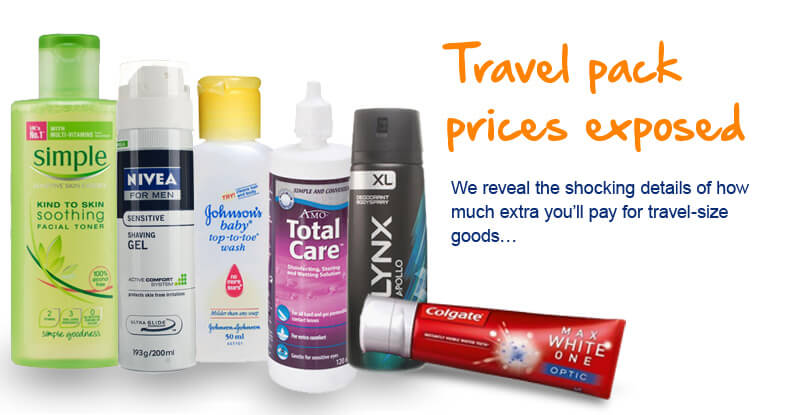
How bad can the markup be? Enormous. One analysis found that a travel-size cosmetic (just 3 ounces of product) cost about 312% more per ounce than buying the standard full-size bottle! In other words, you might be paying four times as much for the same shampoo, just because it’s in a tiny bottle. Ouch.
Examples (illustrative): A full-size 250ml shampoo might be £4 (which is £0.016 per ml), while a 50ml travel bottle of the same shampoo might be £2.50 (that’s £0.05 per ml, over three times the unit price). Or a regular tube of toothpaste, 100ml for £2, versus a travel tube, 25ml for £1.50 – that’s even worse per ml. Retailers make big margins on these mini products.
Why so pricey? You’re paying for the convenience and packaging. Making small bottles and packaging them individually costs the manufacturer more per unit of volume, and stores take advantage of the urgent need travelers have. Also, often the travel section is in airports or convenience stores where everything is pricier.
How to beat the system:
- Decant your own: One of the best strategies is to buy a set of empty travel bottles (they’re inexpensive – you can get like a 4-pack of 100ml or 50ml bottles for a couple of quid) and fill them from your larger bottles at home. Then you’re essentially bringing your regular product at a fraction of the cost. Just make sure they’re well-labelled (you don’t want to brush your teeth with hair gel) and securely closed. Many empty travel bottles are reusable, so it’s a small investment that pays off on every trip.
- Use 2-in-1 products: If you can find multi-use items, you cut down on how many things you need to bring. For example, a combined shampoo/body wash or a moisturizer that also serves as sunscreen, etc. Fewer bottles means fewer things to buy or pack.
- Look for travel kits or freebies: Sometimes you get free sample sizes or bonus travel minis with other purchases (especially cosmetics). These can be handy for one-time trips. Or hotels often supply mini toiletries – you can use those during your stay or even take the partly used ones with you for later in the trip.
- Solid alternatives: For some items, you can avoid liquids altogether. For example, consider a solid shampoo bar instead of liquid shampoo (no liquid limit issues, and they last a long time), or solid soap vs shower gel. Toothpaste tablets or powder instead of paste. Solid lotion bars instead of creams. These eliminate the 100ml issue and can often be more cost-effective because you’re not buying special mini-liquid containers repeatedly.
- Wait until after security: If you truly want full-size and don’t want to decant, you could buy toiletries at the airport after going through security. Items bought after security (duty-free or airport shops) can be taken on the plane even if over 100ml. The downside is that airport prices might be higher than normal stores (though often standard high street pricing). Still, it might be cheaper to buy one normal bottle at Boots in the departure lounge than two or three tiny travel bottles beforehand. Also, many airports have an option where you can pre-order items to pick up after security (often at duty-free prices for perfume etc.). For basic toiletries, just browsing the airport pharmacy/shop works.
- Where possible, use hotel’s or host’s supplies: If you’re staying at a hotel, they will usually provide shampoo, soap, etc. You might not need to bring those at all. If staying with friends/family, you can likely use their supplies for a short trip (ask if you feel necessary). This can lighten your liquid load.
Eye-watering markups have been reported for items like deodorant, sunscreen, toothpaste, etc., in mini form. Airlines also sometimes sell “travel packs” (like a small pouch with a toothbrush, tiny toothpaste, eye mask, etc.) at ridiculous prices – avoid those by preparing your own kit.


So, before you automatically grab those travel minis off the shelf, do a quick calculation: check the price of the full-size. Often, you’ll realise you’re paying many times more per ml. For instance, paying £1.50 for 25ml of toothpaste when a 100ml tube costs £2 – that’s nearly double the price for half the amount. Or £3 for a 50ml sunscreen when 200ml costs £6 – you get the idea.
In summary, travel-size convenience comes at a steep cost. To save money, invest a little time in planning: either transfer your toiletries into small bottles yourself or plan to obtain what you need at your destination (after security or upon arrival). Your wallet will thank you, and you can use those savings for a nice treat on your holiday instead of literally pouring them down the drain.
So read this advice and don’t get caught out by the “travel size tax” on your next trip!
Save Your Battery: Don’t Lose Your Device to a Flat Battery
One of the more recent travel hassles is the rule that your devices need to be charged and able to power on at security (especially on flights to certain destinations). The nightmare scenario: they ask you to turn on your phone, and it’s dead – you could have your phone taken away or be denied boarding. Plus, having a working phone is just plain useful during travel.

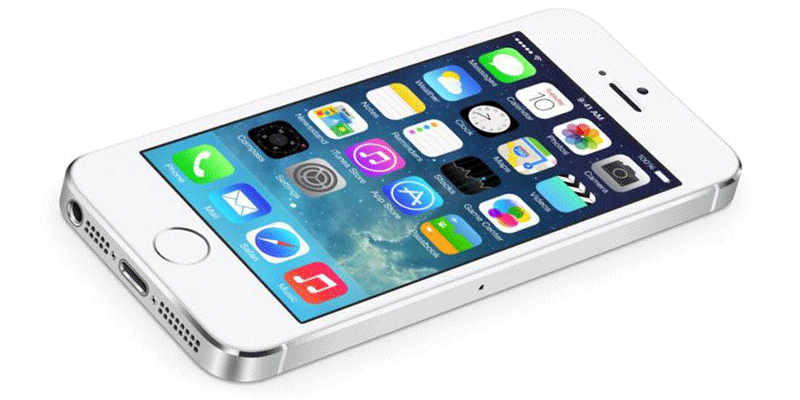
If you’re running low and aren’t sure you’ll have a chance to charge before your flight, here are some tips to prolong your smartphone’s battery life so it doesn’t die on you at the wrong moment:
Keep your phone charged and ready – you might be asked to switch it on at security. Adopting some battery-saving habits can extend your device’s life in travel.
- Close Background Apps: Even if you’re not actively using an app, it could be running in the background (updating, fetching location, etc.) and draining power. On both iOS and Android, bring up the app switcher and swipe closed any app you don’t need right now. Especially things like navigation apps, music streaming, or social media apps – these can quietly eat battery with background activity.
- Turn Off Unneeded Wireless Features: Wi-Fi, Bluetooth, and even mobile data or NFC – if you’re not using them, shut them off. Your phone wastes energy constantly searching for Wi-Fi networks or Bluetooth devices when on. Similarly, if you don’t need to be online for a bit, turning off mobile data can help (your phone won’t be downloading emails or updates in the background). And NFC (used for things like contactless payments) can be off unless you’re actively using it. Basically, if it sends/receives a signal and you don’t need it now, kill it. Some phones have quick toggles or an aeroplane mode, which we’ll cover later.
- Disable GPS/Location Services: GPS is a notorious battery hog. Many apps might ping location services (maps, ride-share apps, even Facebook checking where you are). If you’re not actively using location, turn off Location Services or GPS on your phone. You can usually do this in the quick settings. You can also individually restrict apps from using location in the background in your settings. But the simplest is a full off if you need to save juice. Remember, if GPS is off, any map apps won’t be able to give you location, but you can toggle it back on when needed.
- Switch off Vibrate and Haptic Feedback: The little motor that makes your phone vibrate uses power every time. If you’re trying to save battery, set your phone to silent (no vibrate) or just a ringtone without vibrate. The same goes for haptic feedback – that buzz you feel when typing on the keyboard or pressing buttons – it’s nice, but it uses battery. Turning off keyboard vibrations and other haptics can give you a bit more life. And obviously, avoid games or apps that cause a lot of vibration (some games vibrate for effects – not when you’re low on battery!). Every little bit counts.
- Dim the Screen and Shorten Screen-On Time: Your display is usually the number one battery drain. Lower your screen brightness to as low as you comfortably can. Even a 10-20% reduction in brightness can add meaningful time. Also, go into settings and reduce the screen timeout (auto-lock) to something like 30 seconds or 1 minute, so the screen doesn’t stay on if you set the phone down. And if your phone has an OLED screen, using a dark mode can save some battery (though it’s a smaller difference unless you have many bright white screens). On LCD screens, dark mode doesn’t save much battery, but on OLED it can a bit. Don’t forget to manually turn off the screen whenever possible instead of leaving it glowing.
- Enable Aeroplane Mode (Strategically): If you know you won’t need to make calls or use data for a while – for instance, you’re already at the gate and just waiting, or you’re reading something offline – turn on Aeroplane Mode. This single switch turns off cellular radio, Wi-Fi, Bluetooth, etc., all at once (you can usually re-enable Wi-Fi or Bluetooth individually if you still want those, and it will keep cellular off). Aeroplane mode stops your phone from constantly searching for signals – particularly if you’re in a bad reception area, the phone uses extra power trying to connect. Many airports have patchy cell signal deep inside, so phones crank up their transmit power searching, draining battery fast. Aeroplane mode prevents that. Just remember, you won’t receive texts or calls while it’s on (or any data). But even doing this for 15-20 minutes can save some juice. You can toggle it off periodically to check messages, then back on. Also, if you need to charge quickly, putting the phone in aeroplane mode helps it charge faster, since it’s not doing other tasks.
- Use Battery Saver/Low Power Mode: Modern smartphones have built-in battery saver modes. On iPhone it’s “Low Power Mode”; on Android, usually “Battery Saver” or similar. Turn this on when your battery is getting low (or even preemptively when you know you’ll be away from charging for long). It automatically makes a bunch of optimisations: reduces performance a bit, stops background sync, lowers brightness, etc. It’s very effective at squeezing extra time. Many phones auto-prompt at 20% battery to turn it on – don’t hesitate, that’s what it’s there for. You can even turn it on at 100% if you want to be super conservative – some people do that during travel days to ensure maximum longevity. Just know some functions might be slower or disabled (like auto-fetching emails or background app refresh).
- Avoid Power-Hungry Activities: Streaming video, playing games, using the camera a lot, or anything that keeps the screen on and processor busy will drain battery quickly. If you’re trying to conserve, maybe save that Netflix download for later and read a book or listen to music with the screen off. If you listen to music, keep the screen off (create a playlist so you’re not constantly waking it to change songs).
- Turn off Push Email/Notifications: Constant “push” notifications wake your phone and use data. If you can, turn off push for email (set to manual fetch) or at least close apps like email/messaging so they’re not actively pulling data. Likewise, snooze or turn off non-essential notifications (do you need your shopping app to ping you now? probably not). This reduces background wake-ups.
By implementing these steps, you can significantly extend your phone’s battery life. In a travel context: maybe your phone would normally die after 4 hours of heavy use, but with these measures, you could keep it alive 8+ hours in standby and light use – enough to get through the security check and onto the plane where you might have a chance to charge (some planes have USB or outlets, or you can use a power bank).
Important: If you suspect you might still end up low, carry a portable charger (power bank) in your hand luggage. Just remember it must be in hand luggage, not checked. A small 5,000 mAh power bank can give most phones at least one full charge and is pretty compact. That way, even if your phone is at 0%, you can plug it in and get it turned on if needed. Some airports also have charging stations or even rentable battery packs.
But if you don’t have a charger handy, the above tips are your lifeline. They’re basically putting your phone on a battery diet so it can last until you truly need it.
In conclusion: don’t let a flat battery separate you from your phone (and potentially cause you to fail a security device check). Be mindful of your device’s power. A few tweaks to settings and habits can add hours to your phone’s usable time. Then you’ll sail through security with your phone powered on and avoid the nightmare of having to part with it.
Safe travels – and may your battery bars be ever in your favour!
Stay Charged: Alternative Chargers That Don’t Need an Outlet
Beyond tweaking settings, another strategy to ensure you’re never caught with a dead device is to carry an alternative charging method – something that doesn’t rely on finding a wall socket at the airport (which can be a challenge, especially in older terminals with few plugs, or when everyone else is crowding around them). We all know about standard power banks, but they themselves need to be charged beforehand. What if your power bank is also empty? There are a few interesting gadgets that can help you generate a charge anytime, anywhere – great for emergencies or long stretches without power.


Consider these always-ready charger options:
- Battery Case or AA Battery Emergency Charger: There are phone cases that have an extra battery built-in (battery cases). Those still need charging, but at least it’s attached to your phone giving you extended life. More low-tech, there are emergency chargers that use a standard AA battery to give your phone a bit of charge. You pop in a fresh AA, plug it to your phone, and it transfers maybe 20-30% battery worth – enough for a call or to turn the phone on. It’s not efficient, but AA batteries are easy to carry or buy. This kind of charger is a “power pack” but one that you energize with replaceable batteries (so you could carry a couple of AA’s and you’re good for one phone top-up each). No pre-charging required except having fresh batteries.
- Hand-Crank Chargers: These are neat little devices (often marketed for camping or emergency kits). They have a fold-out handle that you crank by hand to generate electricity. Typically, crank for several minutes to get a few minutes of talk time or a few percent battery. It’s labour-intensive, but in a pinch, you can literally create power out of muscle. One example is those emergency radios with phone charging cranks. They’re small and no matter where you are – even on a plane (turbulence might make it tricky!) – you can use it. The downside: your arm will get tired, and it’s not fast. But it’s infinite as long as you can keep cranking.
- Solar Chargers: If you have access to sunlight (probably not in the security line, but say you’re traveling outdoors later), a solar panel charger can be a great investment. Portable solar chargers nowadays can be as small as a tablet when folded, and you unfold them to expose panels. In direct sun, some can charge a phone in a few hours. Cloudy or indoor, not so much. So this is more for travel where you might be outside (hiking, camping, beach). But even at an airport with a big window and sun streaming in, you could deploy a solar charger near the window and get some trickle charge. It’s a clean, renewable source – just remember sun.
- Kinetic Chargers: These are less common, but the concept is generating power from movement. There are experimental backpack generators or devices that charge as you move (a swinging pendulum or piezoelectric elements in shoes, etc.). One consumer-friendly example is a small device that charges as you shake it (some flashlights work this way – shake flashlight). Not a huge output, but theoretically, you could jog or shake your way to some battery life. Some companies had gadgets like the “nPower PEG” that charge from walking motions. These are niche, but it’s an interesting area of tech.
- Thermal (Heat) Chargers: Believe it or not, you can charge a phone with fire or heat differences. There’s a device called the BioLite CampStove – when you burn wood in it to cook, it converts heat to electricity and can charge a USB device. Obviously intended for camping, not airport use! Another one is those little coffee cup-shaped chargers where you put boiling water in, and it uses the temperature difference. The tech relies on thermoelectric generators. So if you had a heat source (or very cold source on one side, heat on the other), you get power. Not practical for air travel, but interesting. A traveller in remote places could use a portable stove to charge devices while boiling water, etc.
- Wind-Up or “Shake” Flashlight/Charger: Similar to a hand crank, but some flashlights charge by shaking (moving a magnet through a coil). Some newer emergency chargers might use that concept – just shaking back and forth can generate some current. It’s basically a variation of kinetic.
Now, none of these alternative chargers will fully charge a modern smartphone quickly (except maybe a decent-sized solar panel in strong sun, or the BioLite stove if you keep a fire going). They’re mostly meant for emergency top-ups – getting from 0% to 5% so you can power on and make a call or pass a security check.
But they have a big advantage: they don’t rely on being pre-charged or finding an outlet. As long as you have the device, you have a potential way to get power. A power bank is fantastic – until it’s also empty and you have no outlet. These gadgets, however, use external energy sources (sun, manual labour, disposables) to create electricity on the spot.
For travel preparedness, carrying one of these can be smart, especially if you’re going to be in remote areas or uncertain of electricity supply. For example, on a long train or bus ride with no outlets, a solar charger on the window could keep you going. Or during a layover in a small airport without charging points, a hand crank charger could save the day if your phone is about to die and you need to show your boarding pass or contact someone.
They’re also relatively small: many solar chargers fold to the size of a magazine, hand-cranks can be pocket-sized. AA battery chargers are literally like a little tube plus cable. So they’re portable.
One note: If you do carry any of these, security might take a look if they’re unusual (a tangle of panels and wires might catch their eye in X-ray). But they are allowed – nothing dangerous about a solar panel or hand crank.
In fact, some duty-free shops sell emergency chargers (like AA battery ones) for people who get caught with dead phones. But again, huge markup likely – better to buy beforehand.
In essence, these alternative charging technologies ensure you’re always “in charge” wherever you are. You won’t be at the mercy of the elusive airport wall socket or a pre-charged power bank. It’s a great feeling for the prepared traveller: come what may – delays, long transits, power outages – you have a way to keep your critical devices alive.
So, consider adding one of these to your travel kit. Pair it with the battery-saving tips above, and you’ll truly have conquered the power problem of modern travel. Whether it’s cranking a handle for a few minutes or soaking up sun rays, you can avoid the scenario of a confiscated device due to a flat battery.
Stay powered, stay connected, and travel safe!
FAQs
Yes. Essential liquid medications, baby milk, and baby food are exempt from the 100ml limit – but must be declared at security. You may need to show a doctor’s letter for medications over 100ml.
Yes. Laptops and tablets are allowed in cabin bags, but must be charged – you may be asked to power them on. Power banks and spare lithium batteries must go in hand luggage, never in checked bags.
Only small scissors with blades under 6cm and disposable razors (cartridge type) are permitted in hand luggage. Larger blades, straight razors, and box cutters must be checked in.
You’re allowed one disposable lighter or one pack of safety matches, but it must be kept on your person – not in hand luggage or checked luggage.
They can be! For £5-£8 per person, many UK airports offer Fast Track lanes to skip the main security queue. They’re especially useful during peak hours or with young children.
Disclaimer
While we’ve done our best to ensure all information in this guide is accurate and up to date at the time of writing, airport security regulations can change without notice. We strongly recommend checking with your airline and departure airport directly before travelling, especially if you’re carrying restricted items, medications, or specialist equipment. APH cannot accept responsibility for any losses or delays resulting from changes to security rules. Better safe than repacking at the gate!