
Which countries use the euro in 2026? The euro (€) is the official currency of 21 of the 27 European Union (EU) countries, including popular holiday destinations such as Spain, France, Italy, Greece, Portugal, Croatia and Bulgaria. Several countries outside the EU, including Montenegro, Kosovo, Monaco and Andorra, also use the euro.
However, not every European country uses the same currency. Poland, Hungary, Denmark, Sweden, Switzerland and Turkey are among the destinations that continue to use their own national currencies.
If you’re planning a European holiday, city break, cruise or road trip, knowing which currency you’ll need can help you avoid unnecessary exchange fees and make your holiday spending money go further.
At Airport Parking and Hotels (APH), we’ve put together this comprehensive European currency guide to help UK travellers check which countries use the euro, which don’t and how to get the most from their money when travelling abroad.
Last updated: 24 November 2026. This guide includes Bulgaria’s adoption of the euro on 1 January 2026.
European Currencies: Quick Guide for UK Travellers
| Question | Quick answer |
|---|---|
| How many EU countries use the euro? | 21 of 27 |
| How many EU countries do not use the euro? | 6 |
| Which country most recently adopted the euro? | Bulgaria, on 1 January 2026 |
| What is the currency symbol for the euro? | € |
| What is the international currency code for the euro? | EUR |
| Do all European countries use the euro? | No |
| Do countries outside the EU use the euro? | Yes, including Montenegro, Kosovo, Andorra, Monaco, San Marino and Vatican City |
| Does the UK use the euro? | No, the UK uses pound sterling (GBP) |
| Should I pay in pounds or local currency abroad? | Local currency is usually the better option when paying by card |
Which Countries Use the Euro in 2026?
There are currently 21 EU member states that use the euro as their official currency. Together, these countries form the eurozone, also known as the euro area.
If you’re travelling between these countries, you can use the same euro banknotes and coins without needing to exchange your cash at each border.
Full List of the 21 Eurozone Countries
| Country | Currency | Year adopted |
|---|---|---|
| Austria | Euro (EUR) | 1999 |
| Belgium | Euro (EUR) | 1999 |
| Bulgaria | Euro (EUR) | 2026 |
| Croatia | Euro (EUR) | 2023 |
| Cyprus | Euro (EUR) | 2008 |
| Estonia | Euro (EUR) | 2011 |
| Finland | Euro (EUR) | 1999 |
| France | Euro (EUR) | 1999 |
| Germany | Euro (EUR) | 1999 |
| Greece | Euro (EUR) | 2001 |
| Ireland | Euro (EUR) | 1999 |
| Italy | Euro (EUR) | 1999 |
| Latvia | Euro (EUR) | 2014 |
| Lithuania | Euro (EUR) | 2015 |
| Luxembourg | Euro (EUR) | 1999 |
| Malta | Euro (EUR) | 2008 |
| Netherlands | Euro (EUR) | 1999 |
| Portugal | Euro (EUR) | 1999 |
| Slovakia | Euro (EUR) | 2009 |
| Slovenia | Euro (EUR) | 2007 |
| Spain | Euro (EUR) | 1999 |
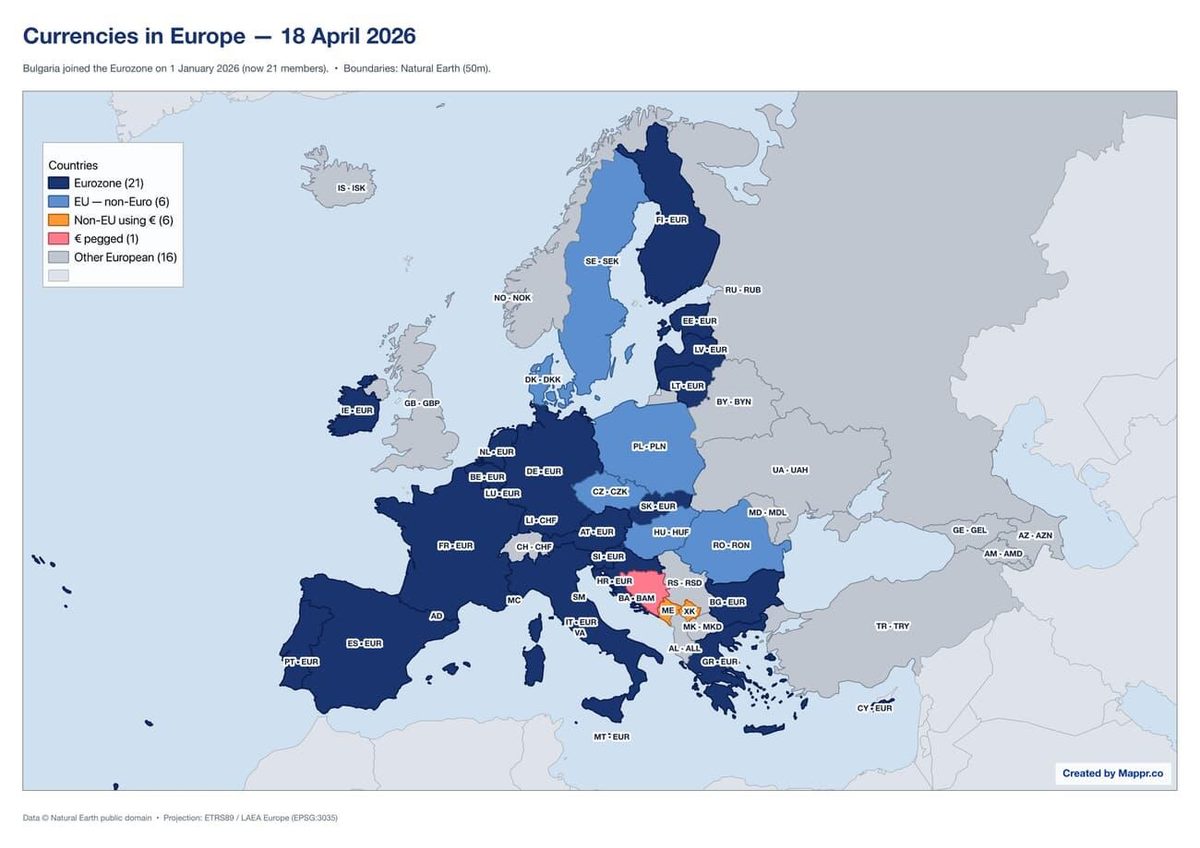
You can check the official list of countries using the euro on the European Union website.
Does Bulgaria Use the Euro in 2026?
Yes. Bulgaria officially adopted the euro on 1 January 2026, becoming the 21st member of the eurozone.
The euro replaced the Bulgarian lev (BGN), which had previously been the country’s national currency. The fixed conversion rate was set at €1 = 1.95583 Bulgarian leva.
For British holidaymakers, this means that euros are now the currency you should take when visiting Bulgarian destinations such as:
- Sunny Beach
- Sofia
- Bansko
- Varna
- Burgas
- Golden Sands
Whether you’re heading to the Black Sea coast for a summer holiday or visiting Bulgaria’s popular ski resorts, you no longer need to purchase Bulgarian leva for everyday spending.
Bulgaria’s one-month dual-currency cash circulation period ended on 31 January 2026. The euro is now the country’s sole legal tender.
If you have Bulgarian leva left over from an earlier holiday, the Bulgarian National Bank provides an indefinite, free-of-charge exchange service for eligible lev banknotes and coins at the official conversion rate. Other exchange providers may have different arrangements.
Find out more about Bulgaria’s membership of the eurozone on the official EU website.
Does Croatia Still Use the Kuna?
No. Croatia replaced the Croatian kuna (HRK) with the euro on 1 January 2023, becoming the 20th member of the eurozone.
Travellers visiting Dubrovnik, Split, Zagreb, Hvar and other Croatian destinations should now use euros.
If you’re researching a holiday using older travel guides, you may still see prices quoted in Croatian kuna. These references are historical and should not be treated as current currency advice.
Which EU Countries Do Not Use the Euro?
As of November 2026, six European Union member states continue to use their own national currencies instead of the euro.
| EU country | Official currency | Currency code | Popular destinations |
|---|---|---|---|
| Czechia (Czech Republic) | Czech koruna | CZK | Prague, Brno |
| Denmark | Danish krone | DKK | Copenhagen, Aarhus, Billund |
| Hungary | Hungarian forint | HUF | Budapest, Lake Balaton |
| Poland | Polish złoty | PLN | Kraków, Warsaw, Gdańsk |
| Romania | Romanian leu | RON | Bucharest, Brașov, Transylvania |
| Sweden | Swedish krona | SEK | Stockholm, Gothenburg, Malmö |
Although some shops, hotels and tourist attractions in these destinations may accept euros, businesses are not generally required to accept them as payment.
Using the local currency is usually the more reliable option and may help you avoid unfavourable conversion rates.
European Countries and Their Currencies: Complete Travel Reference
Travelling through several European countries? Use the alphabetical reference table below to check which currency you’ll need at each destination.
The table includes European countries, Kosovo and several transcontinental and neighbouring countries commonly included in wider European travel itineraries. Their inclusion is for practical travel purposes and does not imply a particular geographical or political classification.
| Country or destination | Uses the euro? | Currency | Code |
|---|---|---|---|
| Albania | No | Albanian lek | ALL |
| Andorra | Yes | Euro | EUR |
| Armenia | No | Armenian dram | AMD |
| Austria | Yes | Euro | EUR |
| Azerbaijan | No | Azerbaijani manat | AZN |
| Belarus | No | Belarusian rouble | BYN |
| Belgium | Yes | Euro | EUR |
| Bosnia and Herzegovina | No | Convertible mark | BAM |
| Bulgaria | Yes | Euro | EUR |
| Croatia | Yes | Euro | EUR |
| Cyprus | Yes | Euro | EUR |
| Czechia (Czech Republic) | No | Czech koruna | CZK |
| Denmark | No | Danish krone | DKK |
| Estonia | Yes | Euro | EUR |
| Finland | Yes | Euro | EUR |
| France | Yes | Euro | EUR |
| Georgia | No | Georgian lari | GEL |
| Germany | Yes | Euro | EUR |
| Greece | Yes | Euro | EUR |
| Hungary | No | Hungarian forint | HUF |
| Iceland | No | Icelandic króna | ISK |
| Ireland | Yes | Euro | EUR |
| Italy | Yes | Euro | EUR |
| Kazakhstan | No | Kazakhstani tenge | KZT |
| Kosovo | Yes | Euro | EUR |
| Latvia | Yes | Euro | EUR |
| Liechtenstein | No | Swiss franc | CHF |
| Lithuania | Yes | Euro | EUR |
| Luxembourg | Yes | Euro | EUR |
| Malta | Yes | Euro | EUR |
| Moldova | No | Moldovan leu | MDL |
| Monaco | Yes | Euro | EUR |
| Montenegro | Yes | Euro | EUR |
| Netherlands | Yes | Euro | EUR |
| North Macedonia | No | Macedonian denar | MKD |
| Norway | No | Norwegian krone | NOK |
| Poland | No | Polish złoty | PLN |
| Portugal | Yes | Euro | EUR |
| Romania | No | Romanian leu | RON |
| Russia | No | Russian rouble | RUB |
| San Marino | Yes | Euro | EUR |
| Serbia | No | Serbian dinar | RSD |
| Slovakia | Yes | Euro | EUR |
| Slovenia | Yes | Euro | EUR |
| Spain | Yes | Euro | EUR |
| Sweden | No | Swedish krona | SEK |
| Switzerland | No | Swiss franc | CHF |
| Turkey (Türkiye) | No | Turkish lira | TRY |
| Ukraine | No | Ukrainian hryvnia | UAH |
| United Kingdom | No | Pound sterling | GBP |
| Vatican City | Yes | Euro | EUR |
Important: Inclusion in this reference table is not a recommendation to visit a particular destination. Travel restrictions, security conditions and payment arrangements can change. Always consult the latest Foreign, Commonwealth & Development Office travel advice before booking.
Which Countries Outside the EU Use the Euro?
You don’t have to be a member of the European Union to use the euro. Several European countries and jurisdictions outside the EU use it as their main currency.
There are two important distinctions: those that have formal monetary agreements with the European Union and those that have adopted the euro independently.
| Country or jurisdiction | Currency | Arrangement |
|---|---|---|
| Andorra | Euro (EUR) | Formal monetary agreement with the EU |
| Monaco | Euro (EUR) | Formal monetary agreement with the EU |
| San Marino | Euro (EUR) | Formal monetary agreement with the EU |
| Vatican City | Euro (EUR) | Formal monetary agreement with the EU |
| Kosovo | Euro (EUR) | Unilateral adoption |
| Montenegro | Euro (EUR) | Unilateral adoption |
Andorra, Monaco, San Marino and Vatican City
These four European microstates use the euro under monetary agreements with the European Union. They are also permitted to issue limited quantities of euro coins featuring their own national designs.
For holidaymakers, this means there’s no need to exchange currency when travelling from France to Monaco, Spain or France to Andorra, or Italy to San Marino and Vatican City.
Montenegro and Kosovo
Montenegro and Kosovo have used the euro since 2002, despite not being members of the European Union or the eurozone.
Both previously used the German Deutsche Mark before switching to the euro. Unlike the four microstates listed above, they do not have formal monetary agreements permitting them to issue their own euro coins.
If you’re visiting Montenegro’s popular coastal destinations, including Kotor, Budva and Tivat, euros are the currency you’ll need.
Which Destinations Outside Geographical Europe Use the Euro?
The euro isn’t limited to mainland Europe. Several islands, overseas regions and territories in the Atlantic Ocean, Caribbean, Indian Ocean, Africa and South America also use it.
| Destination | Associated country | Region | Currency |
|---|---|---|---|
| Canary Islands | Spain | Atlantic Ocean, off Africa | Euro |
| Ceuta | Spain | North Africa | Euro |
| Melilla | Spain | North Africa | Euro |
| Madeira | Portugal | Atlantic Ocean | Euro |
| Azores | Portugal | Atlantic Ocean | Euro |
| Guadeloupe | France | Caribbean | Euro |
| Martinique | France | Caribbean | Euro |
| Saint Martin (French side) | France | Caribbean | Euro |
| Saint Barthélemy | France | Caribbean | Euro |
| French Guiana | France | South America | Euro |
| Réunion | France | Indian Ocean | Euro |
| Mayotte | France | Indian Ocean | Euro |
| Saint Pierre and Miquelon | France | North Atlantic | Euro |
| Akrotiri and Dhekelia | United Kingdom | Cyprus | Euro |
Some of these destinations are integral regions of EU member states, while others use the euro through specific monetary or territorial arrangements. They are not separate eurozone member countries.
For more information, visit the European Central Bank’s guide to where the euro is used outside Europe.
What Currency Do I Need for Popular European Holiday Destinations?
Some holiday islands and territories are better known by their resort names than by the countries they belong to. If you’re unsure which money to take, the following table covers popular destinations visited by UK holidaymakers.
| Holiday destination | Currency to use |
|---|---|
| Majorca, Menorca and Ibiza | Euro (EUR) |
| Tenerife, Lanzarote, Gran Canaria and Fuerteventura | Euro (EUR) |
| Algarve, Lisbon and Porto | Euro (EUR) |
| Madeira | Euro (EUR) |
| Crete, Rhodes, Corfu, Kos and Santorini | Euro (EUR) |
| Paphos, Larnaca and Ayia Napa | Euro (EUR) |
| Northern Cyprus | Turkish lira (TRY) |
| Malta and Gozo | Euro (EUR) |
| Dubrovnik, Split and Hvar | Euro (EUR) |
| Sunny Beach and Bansko | Euro (EUR) |
| Budva and Kotor | Euro (EUR) |
| Antalya, Bodrum and Marmaris | Turkish lira (TRY) |
| Prague | Czech koruna (CZK) |
| Budapest | Hungarian forint (HUF) |
| Kraków and Warsaw | Polish złoty (PLN) |
| Copenhagen | Danish krone (DKK) |
| Stockholm | Swedish krona (SEK) |
| Oslo and Bergen | Norwegian krone (NOK) |
| Geneva, Zurich and Zermatt | Swiss franc (CHF) |
| Reykjavík | Icelandic króna (ISK) |
| Sarandë and Tirana | Albanian lek (ALL) |
| Dublin and Cork | Euro (EUR) |
| Belfast | Pound sterling (GBP) |
| Gibraltar | Gibraltar pound (GIP) and pound sterling (GBP) |
APH tip: If you’re planning a multi-destination holiday, check the currency of every country on your itinerary rather than just your arrival destination.
For example, a road trip from Germany through Switzerland to Italy will take you from the euro to the Swiss franc and back to the euro again.
What Is the Difference Between Europe, the EU, the Eurozone and the Schengen Area?
Europe, the European Union, the eurozone and the Schengen Area are often confused, but they describe different geographical, political, monetary and travel arrangements.
| Term | What it means |
|---|---|
| Europe | A geographical continent containing EU and non-EU countries. |
| European Union (EU) | A political and economic union of 27 member countries. |
| Eurozone | The 21 EU member states that have officially adopted the euro as their currency. |
| Schengen Area | A group of European countries that have generally removed routine checks at their shared internal borders, subject to exceptions. |
| European Economic Area (EEA) | The EU countries plus Iceland, Liechtenstein and Norway, participating in the European single market. |
Membership of one group does not automatically mean membership of another.
- Switzerland is part of the Schengen Area but is not an EU or eurozone member and uses the Swiss franc.
- Poland is an EU and Schengen member but uses the Polish złoty.
- Ireland is an EU and eurozone member but is not part of the Schengen Area.
- Montenegro uses the euro despite not being an EU or eurozone member.
For UK travellers, it’s important to check both the currency and entry requirements of your destination, as these are separate matters.
Why Don’t All EU Countries Use the Euro?
Joining the European Union does not automatically mean adopting the euro. A country must first meet specific economic and legal requirements known as the convergence criteria.
These requirements cover areas such as price stability, government finances, interest rates, exchange rate stability and compatibility with EU monetary law.
Most EU countries that have not yet adopted the euro are expected to do so once the required conditions have been met. However, there is no universal deadline for adoption.
Why Doesn’t Denmark Use the Euro?
Denmark has a formal opt-out from adopting the euro, meaning it is not obliged to replace its national currency with the European single currency.
It continues to use the Danish krone, although the krone’s exchange rate is closely linked to the euro through the European Exchange Rate Mechanism (ERM II).
If you’re travelling to Copenhagen, Billund or elsewhere in Denmark, Danish kroner are the local currency.
Why Doesn’t Sweden Use the Euro?
Sweden continues to use the Swedish krona. Unlike Denmark, Sweden does not have a formal euro opt-out, but it has not completed all the necessary steps for joining the eurozone.
For travellers, this means Swedish kronor remain the currency used for everyday transactions in Sweden.
Which Countries Will Adopt the Euro Next?
Following Bulgaria’s adoption of the euro in January 2026, there are five EU countries without a formal opt-out that are expected to adopt the euro once the required conditions are met:
- Czechia
- Hungary
- Poland
- Romania
- Sweden
There is no confirmed date that applies to all these countries. Future adoption depends on economic conditions, national decisions and approval through the EU’s formal processes.
Until a country officially completes its transition to the euro, holidaymakers should continue to plan their spending around its existing national currency.
Can You Use Euros in the UK, Gibraltar and British Crown Dependencies?
The UK uses pound sterling rather than the euro. However, currency arrangements vary across British Overseas Territories and Crown Dependencies.
| Destination | Principal currency | Can you use UK pounds? |
|---|---|---|
| United Kingdom | Pound sterling | Yes |
| Gibraltar | Gibraltar pound | Yes, generally |
| Jersey | Jersey pound and sterling | Yes |
| Guernsey | Guernsey pound and sterling | Yes |
| Isle of Man | Manx pound and sterling | Yes |
| Akrotiri and Dhekelia | Euro | Do not rely on sterling |
The Gibraltar, Jersey, Guernsey and Manx pounds are linked to pound sterling at an exchange rate of one to one.
However, locally issued banknotes are not generally accepted by retailers in mainland Britain. If you receive local notes during your visit, it may be more convenient to spend them or exchange them before returning home.
Does Ireland Use the Euro or the Pound?
The Republic of Ireland uses the euro, while Northern Ireland uses pound sterling because it is part of the United Kingdom.
If you’re travelling between Dublin and Belfast, for example, you will be moving between two different currency areas.
Does Gibraltar Accept Euros?
Some shops and tourism businesses in Gibraltar may accept euros, but the Gibraltar pound is the local currency and UK sterling is widely accepted.
Where businesses accept euros, they may apply their own exchange rates. British travellers will generally find it more convenient to use sterling.
Can You Use Euros in Countries That Have Their Own Currency?
Sometimes. Hotels, restaurants, attractions and shops in popular tourist areas may voluntarily accept euros even when the euro is not the country’s official currency.
However, acceptance is not guaranteed. Businesses may use unfavourable exchange rates or provide change in the local currency.
Can You Use Euros in Turkey?
The Turkish lira is the official currency of Turkey. Some businesses in resorts such as Antalya, Marmaris, Bodrum and Side may accept euros or British pounds.
However, Turkish lira is generally the more reliable currency for everyday purchases, public transport, local markets and smaller businesses.
Can You Use Euros in Switzerland?
Switzerland uses the Swiss franc. Some hotels, shops and tourist attractions accept euros, but you may receive your change in Swiss francs and the retailer may apply its own exchange rate.
When paying by card, choosing Swiss francs rather than pounds or euros will usually avoid an unnecessary merchant currency conversion.
Can You Use Euros in Poland, Hungary or Czechia?
Some tourist-facing businesses may accept euros, particularly in city centres. However, Poland uses the złoty, Hungary uses the forint and Czechia uses the koruna.
Use the appropriate local currency for more consistent pricing and wider acceptance.
Can You Use Euros in Albania?
The Albanian lek is Albania’s national currency. Euros are commonly accepted by some accommodation providers and tourism businesses, particularly in coastal resorts.
However, you should carry some Albanian lek for smaller purchases, local transport, markets and businesses that do not accept euros or cards.
Does All of Cyprus Use the Euro?
The euro is the official currency of the Republic of Cyprus, including popular holiday destinations such as Paphos, Larnaca, Limassol and Ayia Napa.
In the northern part of Cyprus, the Turkish lira is the principal currency used in everyday transactions, although euros and other currencies may be accepted by some businesses.
What Euro Banknotes and Coins Are in Circulation?
The euro is divided into 100 cents. Euro banknotes and coins can be used across the eurozone regardless of the member country in which they were issued.
| Currency type | Denominations |
|---|---|
| Euro coins | 1 cent, 2 cents, 5 cents, 10 cents, 20 cents, 50 cents, €1 and €2 |
| Common euro banknotes | €5, €10, €20, €50, €100 and €200 |
| €500 banknote | No longer issued, but remains legal tender |
Euro coins have a common European design on one side and a national design on the other. A euro coin issued in Spain can be spent in Greece, Italy, France or any other eurozone country.
For everyday holiday spending, smaller notes are generally more convenient. Some businesses may be reluctant to accept high-value banknotes.
Where Is the Best Place to Exchange Pounds for Euros?
There is no single currency exchange provider that consistently offers the best rate. The amount you receive depends on the exchange rate, any commission, delivery costs and the provider’s available offers.
Before buying holiday money, compare several options.
| Exchange option | Advantages | Things to consider |
|---|---|---|
| Online travel money providers | Easy to compare rates and order in advance | Delivery charges or minimum order values |
| Post Office and high-street providers | Convenient collection and cash availability | Online and in-store rates may differ |
| Travel-friendly debit cards | May offer competitive exchange rates and low overseas fees | Account conditions and ATM charges |
| Travel credit cards | Some offer fee-free foreign purchases | Interest, repayment requirements and cash withdrawal charges |
| Prepaid travel money cards | Can help manage a holiday budget | Loading fees, exchange margins and withdrawal limits |
| Overseas cash machines | Convenient access to local currency | ATM operator fees and currency conversion charges |
| Airport currency exchange desks | Useful for last-minute purchases | Walk-up exchange rates may be less competitive |
APH tip: Compare the total amount of foreign currency you’ll receive for your pounds, rather than focusing solely on claims of zero commission.
A provider advertising commission-free currency exchange may still offer a less competitive exchange rate.
How Much Is £100, £500 or £1,000 in Euros?
The pound-to-euro exchange rate changes regularly, so the amount of euros you receive for your pounds will depend on the rate available when you exchange your money.
To calculate the value, multiply the amount in pounds by the number of euros offered for each pound.
For example, if a currency provider offers an illustrative exchange rate of £1 = €1.15, you would receive the following amounts before any additional fees:
| British pounds | Illustrative euro equivalent |
|---|---|
| £50 | €57.50 |
| £100 | €115.00 |
| £200 | €230.00 |
| £500 | €575.00 |
| £1,000 | €1,150.00 |
| £2,000 | €2,300.00 |
You can check the latest European Central Bank reference exchange rates for an indication of currency movements.
Remember that reference rates are not necessarily the rates offered by banks, travel money providers or card issuers.
Should You Pay in Pounds or Euros When Using Your Card Abroad?
When using a UK bank card in a eurozone country, paying in euros rather than British pounds is usually the better option.
When paying by card or withdrawing money from an overseas cash machine, you may be given the choice to complete the transaction in pounds or the local currency.
If you choose pounds, the retailer or ATM operator may convert the transaction using its own exchange rate. This is known as dynamic currency conversion, or DCC.
Although seeing the transaction in pounds can appear convenient, the conversion may include a significant exchange rate markup.
By selecting the local currency, the conversion can instead be handled according to your card provider’s arrangements. Your bank may still charge a foreign transaction fee, so check its terms before travelling.
How Dynamic Currency Conversion Can Affect Your Holiday Budget
Imagine you’re paying a €100 restaurant bill while on holiday in Spain.
| Payment option | Illustrative cost |
|---|---|
| Pay in euros using a fee-free card at an illustrative rate of £0.86 per euro | £86.00 |
| Pay in pounds using the retailer’s offered conversion | £92.00 |
| Potential saving by choosing euros in this example | £6.00 |
One transaction may not make a significant difference to your holiday budget, but repeated currency conversion markups across accommodation, meals, shopping and activities could increase your overall spending.
For more information, read our guide to overseas debit card fees, comparing 16 UK banks.
Is It Better to Take Cash or Use a Card in Europe?
For most UK holidaymakers, a combination of a travel-friendly bank card and a modest amount of local cash offers a practical balance of convenience and flexibility.
Cards and contactless payments are widely used across much of Europe, particularly in major cities and established tourist destinations. However, cash can still be useful when visiting rural areas, small markets, family-run restaurants and businesses with minimum card payment requirements.
| Payment method | Best used for | Potential drawbacks |
|---|---|---|
| Local cash | Small purchases, tips, markets and emergencies | Risk of loss or theft and unused currency |
| Debit card | Everyday spending and ATM withdrawals | Potential foreign transaction and withdrawal fees |
| Credit card | Larger purchases, some hotel deposits and car hire | Interest charges and potential cash withdrawal fees |
| Prepaid travel card | Budgeting and separating holiday spending | Loading restrictions and potential account fees |
| Mobile wallet | Convenient contactless payments | Depends on merchant acceptance and access to your device |
Having a second payment method is also useful if your main card is lost, stolen, blocked or temporarily unavailable.
A card that offers fee-free spending abroad may still have limits or charges for cash withdrawals. Always check both types of transaction before leaving the UK.
How Many Euros Should You Take on Holiday?
The amount of cash you’ll need depends on your destination, length of stay, accommodation arrangements and whether you intend to pay primarily by card or cash.
For a short European city break, some travellers may find €50 to €150 in cash per adult sufficient for small purchases and emergencies if most expenses are paid by card.
For a longer holiday, rural trip or destination where cash is preferred, you may want to carry or withdraw more as needed.
These are illustrative planning amounts rather than recommended spending allowances. Your actual holiday budget may be considerably higher or lower.
When calculating your spending money, remember to allow for:
- Meals and drinks not included in your accommodation package.
- Local transport, taxis and airport transfers.
- Excursions, museums and attractions.
- Hotel tourist taxes and other local charges.
- Tips, small purchases and souvenirs.
- Unexpected expenses and emergencies.
Travellers on an all-inclusive holiday may need less everyday spending money than those visiting a European capital on a room-only basis.
How Much Cash Can You Take from the UK to Europe?
There is no general rule preventing you from travelling with large amounts of legitimate cash, but you may need to declare it to the relevant customs authorities.
When carrying cash between Great Britain and a country outside the UK, you must generally declare amounts of £10,000 or more, or the equivalent in another currency.
When entering or leaving the European Union, cash of €10,000 or more, or its equivalent in other currencies, must generally be declared to customs.
Different rules can apply to Northern Ireland, groups travelling together, unaccompanied cash and movements between individual European countries.
Check the relevant requirements before travelling:
10 Tips to Make Your Holiday Spending Money Go Further
A little planning before you leave home could help you avoid unnecessary currency conversion costs during your holiday.
- Check your destination’s currency. Don’t assume every European country uses the euro.
- Compare exchange rates before travelling. Check the total amount you’ll receive after any fees.
- Use a travel-friendly bank card. Look for competitive exchange rates and low or no foreign transaction fees.
- Pay in the local currency. Decline unnecessary retailer or ATM currency conversions into pounds.
- Check cash machine charges. Both your own bank and the overseas ATM operator may apply fees.
- Avoid leaving currency exchange until the airport. Compare rates and consider ordering your travel money in advance.
- Carry smaller banknotes. These are generally more convenient for everyday transactions.
- Keep a backup card separately. This can be useful if your main payment card is lost or stolen.
- Set a realistic holiday budget. Include local taxes, transport, activities and unexpected expenses.
- Book airport parking in advance. Comparing parking options before departure can help you manage another important part of your holiday budget.
To help you choose a suitable card for your trip, APH has researched the foreign transaction and cash withdrawal fees charged by 16 UK banks.
APH’s Advice for Stress-Free Spending Abroad
When APH originally published its European currency guide, Nick Caunter, Managing Director at APH, explained the importance of planning holiday spending in advance:
“We created this currency guide to help holidaymakers heading to Europe make sure they’ve got the right money in their wallets. It’s all too easy to leave exchanging currency until the last minute, but by planning ahead, shopping around for the best rates, and knowing what currency you’ll need, you can really make your holiday spending money go further.”
Nick Caunter, APH – original currency guide
That advice remains particularly relevant as European currency arrangements continue to change. Croatia’s move to the euro in 2023 and Bulgaria’s adoption of the currency in 2026 are good examples of why it’s worth checking the latest information before every trip.
When Was the Euro Introduced? A Brief History
The euro was introduced on 1 January 1999 as an electronic and accounting currency. Physical euro banknotes and coins entered circulation on 1 January 2002.
Since then, additional European countries have joined the eurozone, replacing their previous national currencies.
| Year | Eurozone development |
|---|---|
| 1999 | The euro is launched by 11 founding members. |
| 2001 | Greece joins the eurozone. |
| 2002 | Euro banknotes and coins enter circulation. |
| 2007 | Slovenia adopts the euro. |
| 2008 | Cyprus and Malta adopt the euro. |
| 2009 | Slovakia adopts the euro. |
| 2011 | Estonia adopts the euro. |
| 2014 | Latvia adopts the euro. |
| 2015 | Lithuania adopts the euro. |
| 2023 | Croatia becomes the 20th eurozone member. |
| 2026 | Bulgaria becomes the 21st eurozone member. |
Today, approximately 358 million people across the euro area use the same currency, making it easier to compare prices, travel between member countries and make cross-border purchases.
You can learn more about the history and introduction of the euro from the European Central Bank.
Frequently Asked Questions About the Euro and European Currencies
How many countries are in the eurozone in 2026?
There are 21 eurozone member countries in 2026. Bulgaria became the newest member on 1 January 2026, following Croatia’s adoption of the euro in January 2023.
How many EU countries do not use the euro?
Six EU countries do not use the euro: Czechia, Denmark, Hungary, Poland, Romania and Sweden.
Do all EU countries have to adopt the euro?
All EU member states except Denmark are expected to adopt the euro once they meet the required economic and legal conditions. Denmark has a formal opt-out. There is no universal deadline for the remaining countries to join.
Which non-EU countries use the euro?
Andorra, Monaco, San Marino and Vatican City use the euro under formal monetary agreements. Montenegro and Kosovo also use the euro, but have adopted it independently.
What is the newest country to use the euro?
Bulgaria is the newest eurozone member. It adopted the euro on 1 January 2026, replacing the Bulgarian lev.
Does Bulgaria use the lev or euro now?
Bulgaria now uses the euro. Holidaymakers visiting destinations such as Sunny Beach, Sofia, Bansko and Varna should use euros rather than Bulgarian leva.
Does Croatia use euros?
Yes. Croatia introduced the euro on 1 January 2023, replacing the Croatian kuna.
Does Spain use the euro?
Yes. Spain uses the euro, including mainland Spain, the Balearic Islands, the Canary Islands, Ceuta and Melilla.
Do the Canary Islands use euros?
Yes. Tenerife, Lanzarote, Gran Canaria, Fuerteventura and the other Canary Islands are part of Spain and use the euro.
Does Portugal use the euro?
Yes. Portugal uses the euro, including mainland Portugal, Madeira and the Azores.
Does Greece use the euro?
Yes. Greece uses the euro throughout mainland Greece and its islands, including Crete, Rhodes, Kos, Corfu, Mykonos and Santorini.
Does Malta use the euro?
Yes. Malta and Gozo use the euro. Malta adopted the currency on 1 January 2008.
What currency does Turkey use?
Turkey uses the Turkish lira (TRY). Although some tourist businesses accept euros or pounds, the Turkish lira is the country’s official currency.
What currency does Prague use?
Prague uses the Czech koruna (CZK), as Czechia has not adopted the euro.
What currency does Budapest use?
Budapest uses the Hungarian forint (HUF). Some tourist businesses may accept euros, but the forint is Hungary’s national currency.
Does Poland use the euro?
No. Poland uses the Polish złoty (PLN), including in Warsaw, Kraków and Gdańsk.
Do Scandinavian countries use the euro?
Denmark, Norway and Sweden do not use the euro. They use the Danish krone, Norwegian krone and Swedish krona respectively. Finland, which is a Nordic country, uses the euro. Iceland uses the Icelandic króna.
Does Switzerland use the euro?
No. Switzerland uses the Swiss franc (CHF). Some businesses accept euros voluntarily, but you should not rely on them for everyday spending.
Can I spend euros in any European country?
No. Some European countries use their own currencies. While euros may be accepted by selected tourist businesses, you should carry or pay in the appropriate local currency.
Can I use euros left over from a previous holiday?
Yes. Valid euro banknotes and coins can normally be used across countries and territories that accept the euro, regardless of where they were originally obtained.
Are euros the same in every eurozone country?
Yes. The euro has the same monetary value throughout the eurozone. Coins can feature different national designs, but their denominations and values remain the same.
Is it cheaper to buy euros in the UK or abroad?
It depends on the exchange rate, provider fees and your bank card’s overseas charges. Compare the total cost of ordering currency in the UK with using a suitable card or withdrawing money abroad.
Should I pay in GBP or EUR when using my debit card?
When paying in a eurozone country, selecting EUR rather than GBP is usually preferable because it avoids the retailer’s dynamic currency conversion. Check your bank’s foreign transaction fees before travelling.
Can I withdraw euros using my UK bank card?
Yes, provided your card is accepted by the overseas ATM. Your bank may charge foreign transaction or withdrawal fees, and the ATM operator may apply its own charges. Review the total cost before confirming the withdrawal.
Can I exchange unused euros when I return to the UK?
Yes. Many currency exchange providers purchase unused foreign banknotes, although buy-back rates may be less favourable than the rate you originally paid. Some providers do not accept foreign coins. If you’re planning another eurozone holiday, keeping unused euros may be more convenient.
Planning Your Next European Holiday? Start with APH
From booking flights and arranging travel insurance to checking your destination’s currency, preparing for your holiday in advance can help you avoid unnecessary costs and last-minute stress.
Airport parking is another part of your holiday worth organising before you travel. APH has been family-owned since 1980, helping travellers compare airport parking and hotel options across the UK.
Whether you’re heading to Spain for a family beach holiday, visiting Prague for a weekend city break or exploring several European countries on one trip, you can choose from a range of airport parking services, including Park & Ride, Meet & Greet and on-airport parking.
- Gatwick Airport parking
- Heathrow Airport parking
- Manchester Airport parking
- Meet & Greet airport parking
Ready for your next holiday? Compare airport parking prices and book online with APH before you travel.
Related APH Travel Guides
Make the most of your holiday budget and prepare for your next trip with more advice from APH.
- Using your debit card abroad: Foreign transaction fees for 16 UK banks compared
- Airline extra legroom seat prices
- Latest travel advice, holiday guides and destination inspiration
Sources and Methodology
This guide updates APH’s previous European currency research to reflect eurozone membership and currency arrangements in November 2026, including Bulgaria’s adoption of the euro.
Eurozone membership and monetary arrangements are based on information published by the European Union and European Central Bank. UK and EU government guidance provides the basis for the cash declaration information.
Exchange rate examples are hypothetical illustrations rather than live currency quotations. Payment acceptance, bank fees and exchange rates can vary between locations and providers.
- European Union – Countries using the euro
- European Union – Bulgaria country profile
- European Central Bank – The euro outside Europe
- European Central Bank – History and introduction of the euro
- European Central Bank – Reference exchange rates
- GOV.UK – Cash declaration requirements
- European Union – Carrying cash when travelling
This article is intended as a general travel information guide. Always check current currency arrangements, financial provider terms and official travel requirements before departure.
Do the shops/hotels in Switzerland accept the Euros besides the official Swiss currency, the Swiss Franc?
One has been forgotten, Switzerland does accept but gives Franks in return.
Great list though. Thanks!
Thank you for your message. I have updated the page. Thanks again.
Best …
Thank you for the convenient list. Saved time and so much energy