

Spotted a rash on your child the morning of your flight, or woken up with it yourself? Chickenpox days before a trip is one of the most common reasons UK families end up at the airport not knowing if they can board. The good news is that the rules are clear, well documented, and usually solvable with a bit of planning. This guide covers what every major airline serving the UK requires, what counts as proof you are no longer infectious, and what to do next if it happens to you.
Can you fly with chickenpox
No, not while you are still infectious. Airlines are legally entitled to refuse boarding to anyone showing signs of a contagious illness, and gate staff will use their own judgement if they see active spots or blisters. Chickenpox spreads through the air and through direct contact with fluid from the blisters, so a single infectious passenger in a sealed cabin is treated as a real risk to other travellers, particularly pregnant women, newborns, and anyone who is immunocompromised.
Once every blister has dried and scabbed over and no new spots are appearing, most airlines will let you travel, although the exact waiting period and paperwork differ by carrier. Some will also want a letter from a GP confirming you are no longer infectious, even once the rash has fully crusted. The table below sets out the current position for the airlines most commonly used by UK travellers.

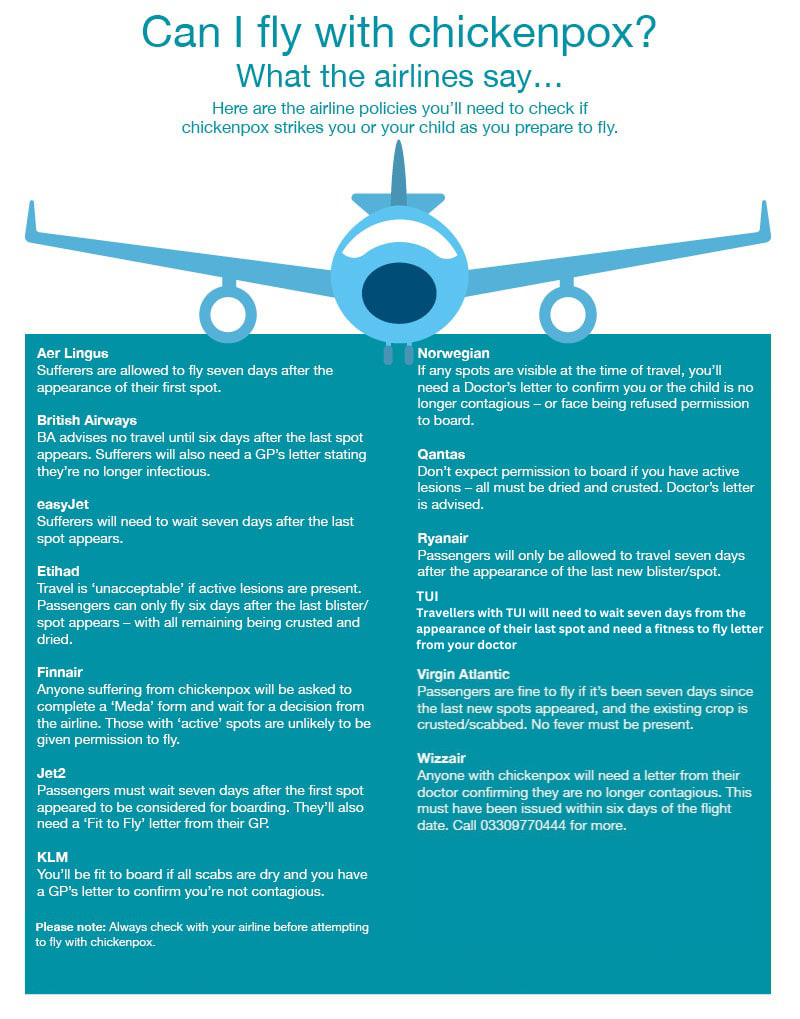
Airline chickenpox policies at a glance
Policies are reviewed regularly and can change without notice, so treat this as a starting point and confirm with your airline before you travel, especially if symptoms have appeared in the last week.
| Airline | Waiting period | Doctor’s letter needed |
|---|---|---|
| Aer Lingus | 7 days after the first spot appears | Recommended |
| British Airways | 6 days after the last blister appears and scabs over | Required |
| easyJet | 7 days after the last spot appears | Recommended if symptoms are visible |
| Etihad | 6 days after the last blister appears, once crusted | Required, medical form may apply |
| Finnair | Assessed case by case via special assistance form | Required |
| Jet2 | 7 days after the first spot appears | Required, fit to fly letter |
| KLM | Once all scabs are dry | Required |
| Norwegian | Until no spots are visible | Required if any spots remain visible |
| Qantas | Until all lesions are dried and crusted | Advised |
| Ryanair | 7 days after the last new spot appears | Recommended |
| TUI | 7 days after the last new spot appears | Required, fitness to fly letter |
| Virgin Atlantic | 7 days after the last new spot, no fever | Recommended |
| Wizz Air | Issued within 6 days of the flight date | Required, medical certificate |
Two patterns are worth noting across this list. First, most carriers settle on either a six or seven day count from the last new spot, not the first one, so the clock resets every time a fresh spot appears. Second, almost every airline wants written confirmation from a doctor once symptoms are still visible at all, even if the blisters have started to crust. A letter is rarely required if every trace has cleared before the waiting period ends.
What a fit to fly letter needs to include
A fit to fly letter from a GP or travel clinic doctor should confirm the diagnosis, the date the first spot appeared, and that all blisters have now scabbed over with no new spots forming. Most airlines want this letter dated close to the travel date, often within five to seven days of departure, so timing the appointment matters. UK GP surgeries do not always offer this service due to appointment pressure, in which case a private travel clinic or online GMC registered doctor service can usually issue one on the same day.
What if chickenpox appears on holiday, not before you fly out
The same rules apply on the way home. If symptoms appear while you are abroad, contact your travel insurer straight away, and see a local doctor or hotel doctor to get a diagnosis on record. You will likely need to extend your stay until the contagious period has passed and, in most cases, get a fit to fly letter from a doctor in the country you are visiting before the airline will let you board the return flight.
Entry rules at your destination can also be stricter than the airline’s own policy. Countries including the United States apply their own checks on contagious illness at the border, separate from anything the airline requires for boarding. Always check the entry requirements for your destination country as well as the airline policy before you travel.
Does travel insurance cover chickenpox
Most comprehensive travel insurance policies will cover cancellation or curtailment caused by chickenpox, provided the policy was bought before the illness appeared and you can show medical evidence of the diagnosis and dates. Buying cover at the same time you book the trip, rather than waiting until closer to departure, is the only way to be certain you are protected if chickenpox strikes at the worst possible moment. Budget policies sometimes exclude infectious illness, so it is worth checking the wording rather than assuming cover is automatic.
Chickenpox explained
Chickenpox is caused by the varicella zoster virus and is best known for the itchy, fluid filled rash that gives the illness its name. It mostly affects children, though anyone who has not previously had it, or been vaccinated against it, can catch it at any age. Most people develop lifelong immunity after one episode, but it can be more serious in adults, pregnant women, newborn babies, and people with a weakened immune system.
How long is chickenpox contagious for
Someone with chickenpox is contagious from around one to two days before the rash first appears, right through until every blister has scabbed over. This typically takes five to six days from the rash starting, though it can run longer if new spots keep appearing in waves.
How does chickenpox spread
The virus spreads through coughing and sneezing, through direct contact with the fluid inside the blisters, and through contaminated surfaces or objects. Sharing a room or a confined space, such as an aircraft cabin, with an infected person for fifteen minutes or more is enough for transmission to occur even without direct contact.
How to ease chickenpox symptoms at home
- Use paracetamol for fever and discomfort, choosing an age appropriate product such as Calpol for children and following the dosage on the packet.
- Apply a cooling or moisturising lotion to ease the itching.
- Pat rather than scratch the skin, since broken skin is more likely to become infected.
- Keep up fluids, particularly with children, who can go off food and drink while unwell.
Frequently asked questions
No, not while you are still contagious. Airlines can refuse boarding to anyone showing visible spots or blisters. Most carriers allow travel once every blister has scabbed over and the required waiting period, usually six or seven days from the last new spot, has passed.
Most UK airlines require six to seven days from the appearance of the last new spot, with all blisters fully crusted over. British Airways and Etihad use a six day rule, while easyJet, Ryanair, Jet2, TUI and Virgin Atlantic use seven days.
Most airlines ask for a doctor’s letter confirming you are no longer infectious if any signs of chickenpox, including scabs, are still visible at the time of travel. Once every trace has fully cleared before the waiting period ends, a letter is less commonly required, though it is sensible to carry one regardless.
You will usually need to extend your stay until the contagious period has passed, get a diagnosis and fit to fly letter from a local doctor, and contact your travel insurer to discuss the additional costs. Check the airline’s policy and your destination’s entry rules before attempting to fly home.
Most comprehensive policies cover cancellation or curtailment due to chickenpox if the policy was bought before symptoms appeared and you have medical evidence of the diagnosis. Some budget policies exclude infectious illness, so check the policy wording.
Possibly. Some countries, including the United States, apply their own entry checks for contagious illness separate from the airline’s boarding policy. Always check the destination country’s current entry requirements alongside your airline’s policy before you travel.
Airline policies are reviewed regularly and can change without notice. Always confirm directly with your airline before travelling, and book your APH.com airport parking and travel insurance early so you are covered if illness disrupts your plans.